#InterSystems IRIS for Health

0 Followers · 2.3K Posts

InterSystems IRIS for Health™ is the world’s first and only data platform engineered specifically for the rapid development of healthcare applications to manage the world’s most critical data. It includes powerful out-of-the-box features: transaction processing and analytics, an extensible healthcare data model, FHIR-based solution development, support for healthcare interoperability standards, and more. All enabling developers to realize value and build breakthrough applications, fast. Learn more.

Question Giulia Ghielmi · Oct 30, 2025

Hello everyone! 👋

I have a question regarding roles and resources. 

To give you some context: I have a user who has been assigned only the role %HS_UsageDashboard_Access.This allows them to access the dashboards correctly (by giving the direct URL). Then,  if I try to access the Management Portal with this same user, I can log in with no access to any resources within it (as expected).

3
0 64
Article Andrew Sklyarov · Nov 8, 2025 4m read

When I started my journey with InterSystems IRIS, especially in Interoperability, one of the initial and common questions I had was: how can I run something on an interval or schedule? In this topic, I want to share two simple classes that address this issue. I'm surprised that some similar classes are not located somewhere in EnsLib. Or maybe I didn't search well? Anyway, this topic is not meant to be complex work, just a couple of snippets for beginners.

0
0 29
InterSystems Official Aya Heshmat · Mar 27, 2025 4m read

The Interoperability user interface now includes modernized user experiences for the DTL Editor and Production Configuration applications that are available for opt-in in all interoperability products. You can switch between the modernized and standard views. All other Interoperability screens remain in the Standard user interface. Please note that changes are limited to these two applications and we identify below the functionality that is currently available. 

23
4 707
Article Andreas Schneider · Apr 22, 2025 4m read

When using standard SQL or the object layer in InterSystems IRIS, metadata consistency is usually maintained through built-in validation and type enforcement. However, legacy systems that bypass these layers—directly accessing globals—can introduce subtle and serious inconsistencies.

2
0 150
Article Tomoko Furuzono · Nov 6, 2025 2m read

InterSystems FAQ rubric

When exporting using the Export() method of the %Library.Global class, if the export format (fourth argument: OutputFormat) is set to 7, "Block format/Caché block format (%GOF)," mapped globals cannot be exported (only globals in the default global database of the namespace are exported). To export mapped globals in "Block format/Caché block format (%GOF)," specify the database directory to which you want to map them in the first parameter of %Library.Global.Export().

An example of execution is shown below. 

0
0 24
Announcement Brenna Quirk · Nov 6, 2025

Hi, Community!

Looking for an efficient way to allow providers to see whether prior authorization is required? See how the Coverage Requirements Discovery (CRD) module of the InterSystems Payer Services ePrior Authorization solution can help:

Coverage Requirements Discovery

<iframe allowfullscreen="" frameborder="0" height="360" src="https://www.youtube.com/embed/MY1If1CEjrM?utm_source=youtube&utm_medium=social&utm_campaign=MY1If1CEjrM" width="640"></iframe>

In this video, you will learn how CRD allows providers to connect an EHR to a payer system to evaluate coverage.

Watch the full playlist on YouTube(10m).

0
0 19
Article Ashok Kumar T · Oct 20, 2025 11m read

What is XML?

XML(eXtensible Markup Language) is a flexible, text-based, andplatform-independentformat used to store and transport data in a well-structured way that is both human- and machine-readable. XML permits users to define custom tags to describe the meaning and organization of their data. For example: <book><title>The Hitchhiker's Guide</title></book>.

3
5 163
Question Kevin Mayfield · Nov 6, 2025

I have a quite complex FHIR Implementation Guide (IG) which is based on several other FHIR IGs. It's likely the versions of IGs conflict with each other.
From what I understand, I would need to load in all the other FHIR IG's first? 
I don't actually need FHIR profiles to be in our FHIR Repository - I'm just after terminology and the examples for our test system.
Is it possible to load a FHIR IG just as data? (I think I mean here, ignore the FHIR profiles and dependencies between them)

1
0 23
Article Ashok Kumar T · Feb 17, 2025 6m read

What is JWT?

JWT (JSON Web Token) is an open standard (RFC 7519) that offers a lightweight, compact, and self-contained method for securely transmitting information between two parties. It is commonly used in web applications for authentication, authorization, and information exchange.

A JWT is typically composed of three parts:

1. JOSE (JSON Object Signing and Encryption) Header
2. Payload
3. Signature

These parts are encoded in Base64Url format and concatenated with dots (.) separating them.

Structure of a JWT

Header

{ "alg": "HS256", "typ": "JWT"}

Payload

3
8 389
InterSystems Official Carmen Logue · Nov 5, 2025

InterSystems IRIS Adaptive Analytics version 2025.4.1 is now available from the InterSystems Software Distribution page.  This release includes AtScale 2025.4.1 and is compatible with the existing  Adaptive Analytics User-Defined Aggregate Function (UDAF) file - 2024.1.  New features included in AtSCale's 2025 releases include:

  • Several MDX improvements to better handle null values and semi-additive measures like year-to-date.
  • New parameters to enable setting the visibility of calculations and calculation groups in BI tools.
  • Support for inbound query crossjoins that return empty cells
0
0 30
Article Theo Stolker · Feb 17, 2025 2m read

For one of our customers I had to integrate with the AFAS imageconnector endpoint /imageconnector/{imageId}?format={format}. This endpoint returns in a json message with the image as a base64-encoded string property, in addition to the mimetype for the image:

/// Image Object
Class Mycustomer.Model.AfasGet.Image Extends (%SerialObject, %XML.Adaptor, %JSON.Adaptor)
{
/// file data (base64 encoded)
Property Filedata As %String(%JSONFIELDNAME = "filedata");

/// MimeType e.g. "image/jpeg"
Property MimeType As %String(%JSONFIELDNAME = "mimetype");
}

In the Message class, we tried handling this like:

Property Image As Mycustomer.Model.AfasGet.Image;

/// AFAS GetImage response
/// get /imageconnector/{imageId}?format={format}
Method LoadFromResponse(httpResponse As %Net.HttpResponse, caller As %String = "") As %Status
{
	Set sc = $$$OK

	If $$$LOWER($Piece(httpResponse.ContentType,";",1))="application/json",httpResponse.StatusCode = "200" {
		set ..Image = ##class(Mycustomer.Model.AfasGet.Image).%New()
		set ..status = ..Image.%JSONImport(httpResponse.Data)
	}

	Return sc
}

This all worked fine until at some point the size of the filedata became larger than the $$$MaxStringLength (3641144), in which case a MAXSTRING exception was raised.

The logical next step was to change the type of the filedata property to %Stream.GlobalCharacter:

/// Image Object
Class Mycustomer.Model.AfasGet.Image Extends (%SerialObject, %XML.Adaptor, %JSON.Adaptor)
{
/// file data (base64 encoded)
Property Filedata As %Stream.GlobalCharacter(%JSONFIELDNAME = "filedata");

/// MimeType e.g. "image/jpeg"
Property MimeType As %String(%JSONFIELDNAME = "mimetype");
}

But that didn't work, %JSONImport() would still raise a MAXSTRING error.

I then tried Python, but as I am not a python wizard, I gave up on that route eventually.

Thanks to the answer from https://community.intersystems.com/user/steven-hobbs on https://community.intersystems.com/post/maxstring-trying-read-string-json-object#comment-250216, I then learned that it is possible and straightforward to retrieve json string properties into a stream using image.%Get("filedata", , "stream")):

Method LoadFromResponse(httpResponse As %Net.HttpResponse, caller As %String = "") As %Status
{
	Set sc = $$$OK

	If $$$LOWER($Piece(httpResponse.ContentType,";",1))="application/json",httpResponse.StatusCode = "200" {
		set ..Image = ##class(Mycustomer.Model.AfasGet.Image).%New()
		set image = {}.%FromJSON(httpResponse.Data)
		set ..Image.MimeType = image.mimetype
		set ..Image.Filedata = ##class(%Stream.GlobalCharacter).%New()
		do ..Image.Filedata.CopyFrom(image.%Get("filedata", , "stream"))
	}

	Return sc
}

I am still puzzled as how I would be able to instruct the %JSON.Adaptor class and use the built-in logic to map to a stream. If there is anyone out there that knows how to do this, please let me know!

3
1 283
Article Laura Blázquez García · Feb 23, 2025 4m read

When we create a FHIR repository in IRIS, we have an endpoint to access information, create new resources, etc. But there are some resources in FHIR that probably we wont have in our repository, for example, Binary resource (this resource returns a document, like PDF for example).

I have created an example that when a Binary resource is requested, FHIR endpoint returns a response, like it exists in the repository. 

7
6 336
Article Andrew Sklyarov · Nov 2, 2025 7m read

Over time, while I was working with Interoperability on the IRIS Data Platform, I developed rules for organizing a project code into packages and classes. That is what is called a Naming Convention, usually. In this topic, I want to organize and share these rules. I hope it can be helpful for somebody.


4
2 82
Announcement Larry Finlayson · Nov 3, 2025
    Using InterSystems Embedded Analytics – Virtual December 1-5, 2025

    Embed analytics capabilities in applications and create the supporting business intelligence cubes.
    This 5-day course teaches developers and business intelligence users how to embed real-time analytics capabilities in their applications using InterSystems IRIS® Business Intelligence.
    This course presents the basics of building data models from transactional data using the InterSystems IRIS BI Architect, exploring those models and building pivot tables and charts using the InterSystems IRIS BI Analyzer, as well as creating

0
0 21
Article Chi Wan Chan · Oct 30, 2025 2m read

Hi All,

First I want give a Shout Out to @Theo Stolker  and @Rupert.Young. Because they helped me with the solution.

 When you're using the EnsLib.SQL.Snapshot as a Property in the Response Message to return Snapshot data (,e.g.: from Business Operation to Business Process,) the Snapshot data won't be cleaned with the Purge messages task/service.

Class ResponseMessage Extends Ens.Response

{

    Property SnapshotProp As EnsLib.SQL.Snapshot;

}

The data will be stuck in the global: ^Ens.AppData. You can find it with this query in System>Globals:  ^Ens.AppData("EnsLib.SQL.Snapshot",

1
0 49
Question Robert Hildebrand · Oct 30, 2025

Hello,I am currently facing the task of retrieving or sending HL7 messages from a web API. Since we only send HL7 messages via internal sockets, web APIs are relatively new to me.The following is my plan for the new interface:I have created a new custom business service that periodically sends requests to a business process. In this business process, the HTTP request (HTTP.GenericMessage) is then created from scratch. The special feature is the "Authorisation" header field, where a signature is inserted, which consists of a base64-encoded hash value. The request is then sent to the API via a

4
0 51
Article Thomas Dyar · Mar 25, 2025 2m read

Introduction

In InterSystems IRIS 2024.3 and subsequent IRIS versions, the AutoML component is now delivered as a separate Python package that is installed after installation. Unfortunately, some recent versions of Python packages that AutoML relies on have introduced incompatibilities, and can cause failures when training models (TRAIN MODEL statement). If you see an error mentioning "TypeError" and the keyword argument "fit_params" or "sklearn_tags", read on for a quick fix.

Root Cause

1
0 232
Question Mark OReilly · Oct 27, 2025

We are trying to mark a hl7 nack as "completed" to ignore an error and not generate the alert. 

We can remove from adding a managed alert or add another router in 

When Nack of CR of 

Date of birth in PID.7 must not be empty

We tried via this but i think it's only for an actual IRIS alert errror not the HL7 error code/description 

E*Date of birth in PID.7 must not be empty=C,:?CR=C,:?R=RF,:?E=S,:~=S,:?A=C,:*=S,:I?=W,:T?=C

3
0 43
Article Kate Lau · Oct 13, 2025 13m read

Hi all,

Let's do some more work about the testing data generation and export the result by REST API.😁

Here, I would like to reuse the datagen.restservice class which built in the pervious article Writing a REST api service for exporting the generated patient data in .csv

This time, we are planning to generate a FHIR bundle include multiple resources for testing the FHIR repository.

Here is some reference for you, if you want to know mare about FHIR The Concept of FHIR: A Healthcare Data Standard Designed for the Future

OK... Let's start😆

6
0 106
Question PaulSomebody · Oct 24, 2025

Hi,

  We have some concerns on how to implement FHIR, do we do facade?, how do we get resources?, what is a resource?, is a resource "Patient" or an instance of a patient?, How can we have a FHIR repository AND send the patient details to healthshare MPI?

  Has anyone correctly created a FHIR server that has custom methods?, handles "normal" methods and forwards onto Healthshare MPI , processing the response and creates a accurate FHIR response back to the calling system.

2
0 54
Article Robert Cemper · Oct 21, 2025 2m read

If you start with InterSystems ObjectScript, you will meet the XECUTE command.
And beginners may ask: Where and Why may I need to use this ?

The official documentation has a rich collection of code snippets. No practical case.
Just recently, I met a use case that I'd like to share with you.

The scenario:

When you build an IRIS container with Docker, then, in most cases,
you run the  initialization script  

iris session iris < iris.script 
1
3 78
Article sween · May 14, 2025 7m read

Real Time FHIR® to OMOP Transformation

This part of the OMOP Journey,  we reflect before attempting to challenge Scylla on how fortunate we are that InterSystems OMOP transform is built on the Bulk FHIR Export as the source payload.  This opens up hands off interoperability with the InterSystems OMOP transform across several FHIR® vendors, this time with the Google Cloud Healthcare API.

Google Cloud Healthcare API FHIR® Export

1
2 111
Question Scott Roth · Oct 24, 2025

According to the Documentation  EnsLib.Workflow.TaskRequest has the following fields...

  • %Action
  • %Command
  • %FormFields
  • %FormTemplate
  • %FormValues
  • %Message
  • %Priority
  • %Subjext
  • %TaskHandler
  • %Title
  • %UserName

I want to be able to capture the Source, Session ID, and any other Identifiers outside of the Error so it will show up on the Task List.

I am struggling how to build a csp template for me to be able to capture additional fields to send to the Workflow Operation.

0
0 30
Article Murray Oldfield · Aug 26, 2025 6m read

I am regularly contacted by customers about memory sizing when they get alerts that free memory is below a threshold, or they observe that free memory has dropped suddenly. Is there a problem? Will their application stop working because it has run out of memory for running system and application processes? Nearly always, the answer is no, there is nothing to worry about. But that simple answer is usually not enough. What's going on?

Consider the chart below. It is showing the output of the free metric in vmstat. There are other ways to display a system's free memory, for example, the free -m command. Sometimes, free memory will gradually disappear over time. However, the chart below is an extreme example, but it is a good example to illustrate what's going on.

image

As you can see, at around 2 am, some memory is freed, then suddenly drops close to zero. This system is running the IntelliCare EHR application on the InterSystems IRIS database. The vmstat information came from a ^SystemPerformance HTML file that collects vmstat, iostat and many other system metrics. What else is going on on this system? It is the middle of the night, so I don't expect much is happening in the hospital. Let's look at iostat for the database volumes.

image

There is a burst of reads at the same time as the free memory drops. The drop in reported free memory aligns with a spike in large block-sized reads (2048 KB request size) shown in iostat for the database disk. This is very likely a backup process or file copy operation. Ok, so correlation isn't causation, but this is worth looking at, and it turns out, explains what's going on.

Let's look at some other output from ^SystemPerformance. The command free -m is run at the same rate as vmstat (for example, every 5 seconds), and is output with a date and time stamp, so we can also chart the counters in free -m.

The counters are:

  • Memtotal – Total physical RAM.
  • used – RAM in active use (apps + OS + cache).
  • free – Completely unused RAM.
  • shared – Memory shared between processes.
  • buf/cache – RAM used for buffers & cache, reclaimable if needed.
  • available – RAM still usable without swapping.
  • swaptotal – Total swap space on disk.
  • swapused – Swap space currently in use.
  • swapfree – Unused swap space.

Why does free memory drop at 2 am?

  • The large sequential reads fill the filesystem page cache, temporarily consuming memory that appears as "used" in free -m.
  • Linux aggressively uses otherwise idle memory for caching I/O to improve performance.
  • Once the backup ends (≈ 03:00), memory is gradually reclaimed as processes need it.
  • Around 6 am, the hospital starts to get active, and memory is used for IRIS and other processes.

Low free memory is not a shortage, but rather the system utilising "free" memory for caching. This is normal Linux behaviour! The backup process is reading large amounts of data, which Linux aggressively caches in the buffer/cache memory. The Linux kernel converts "free" memory into "cache" memory to speed up I/O operations.

Summary

The filesystem cache is designed to be dynamic. If a process requires memory, it will be immediately reclaimed. This is a normal part of Linux memory management.


Does Huge Pages have an impact?

For performance and to reserve memory for IRIS shared memory, the best practice for production IRIS deployments on servers with large memory is to use Linux Huge Pages. For IntelliCare, a rule of thumb I use is to use 8 GB memory per core and around 75% of memory for IRIS shared memory -- Routine and Global buffers, GMHEAP, and other shared memory structures. How shared memory is divided up depends on application requirements. Your requirements could be completely different. For example, using that CPU to memory ratio, is 25% enough for your application IRIS processes and OS processes?

InterSystems IRIS uses direct I/O for database and journal files, which bypasses the filesystem cache. Its shared memory segments (globals, routines, gmheap, etc.) are allocated from Huge Pages.

  • These huge pages are dedicated to IRIS shared memory and do not appear as "free" or "cache" in free -m.
  • Once allocated, huge pages are not available for filesystem cache or user processes.

This explains why the free -m metrics look "low" even though the IRIS database itself is not starved of memory.


How is the free memory for a process calculated?

From above, in free -m, the relevant lines are:

  • free – Completely unused RAM.
  • available – RAM still usable without swapping.

Available is a good indicator — it includes reclaimable cache and buffers, showing what’s actually available for new processes without swapping. What processes? For a review, have a look at InterSystems Data Platforms and Performance Part 4 - Looking at Memory . A simple list is: Operating system, other non-IRIS application processes, and IRIS processes.

Let's look at a chart of the free -m output.
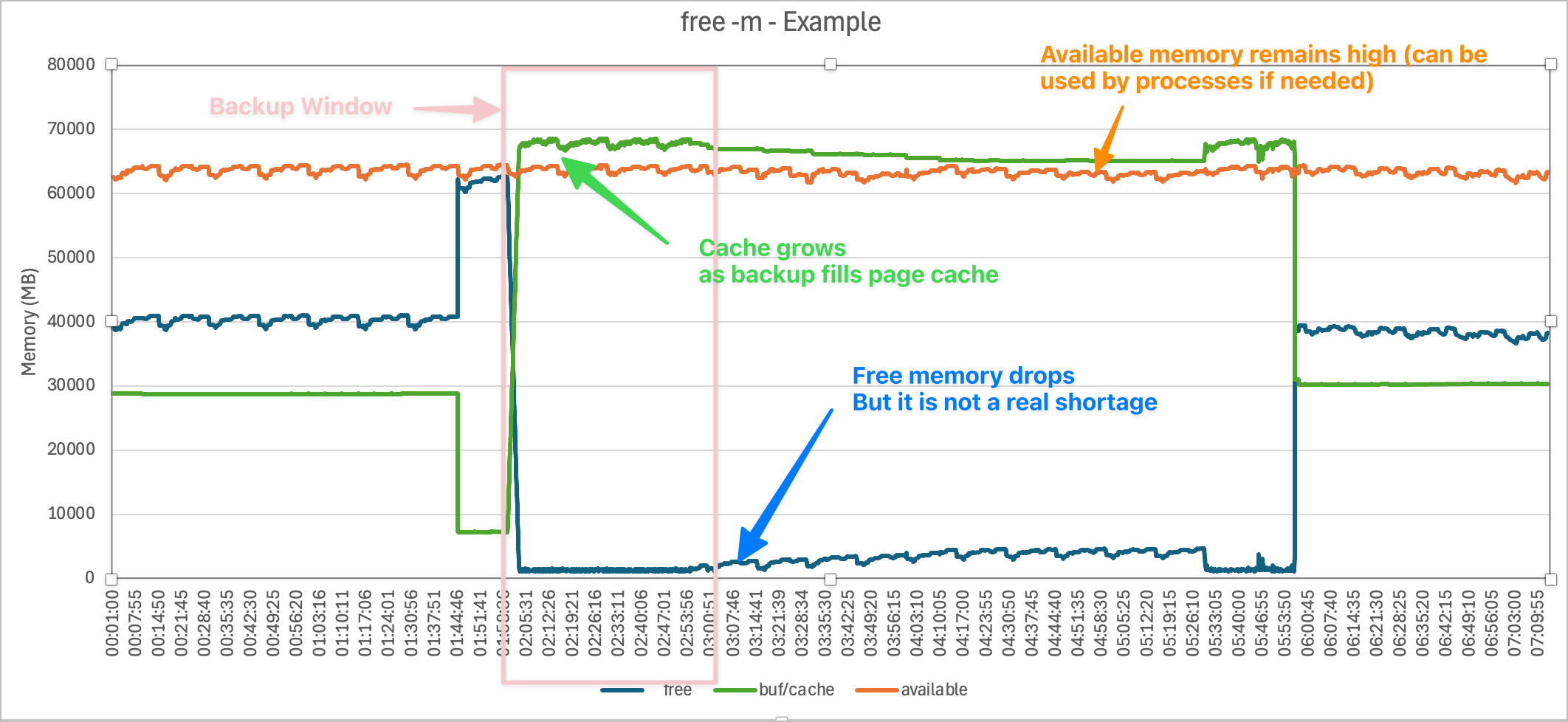
image

Although free drops near zero during the backup, available remains much higher (tens of GB). That means the system could provide that memory to processes if needed.

Where do huge pages appear in free?

By default, free -m does not show huge pages directly. To see them, you need /proc/meminfo entries like HugePages_TotalHugePages_Free, and Hugepagesize.

Because the OS reserves huge pages at startup, they are effectively invisible to free -m. They are locked away from the general memory pool.

Summary

  • The low "free memory" seen around 02:00 is caused by the Linux page cache being filled by backup reads. This is expected behaviour and does not indicate a memory shortage.
  • Huge pages reserved for IRIS are unaffected and continue serving the database efficiently.
  • The actual memory available to applications is best measured by the available column, which shows the system still has sufficient headroom.

But wait, what about if I don't use Huge Pages?

It is common not to use Huge Pages on non-production or systems with limited memory -- performance gains of Huge Pages are usually not significant under 64 GB, although it is still best practice to use Huge Pages to protect IRIS shared memory.

Sidebar. I have seen sites get into trouble by allocating Huge Pages smaller than shared memory, which causes IRIS to try and start with very small global buffers or fail to start if memlock is used (consider memlock=192 for production systems).

Without Huge Pages, IRIS shared memory segments (globals, routines, gmheap, etc.) are allocated from normal OS memory pages. This would show up under “used” memory in free -m. It would also contribute to “available” going lower, because that memory can’t easily be reclaimed.

  • used – Much higher, reflecting IRIS shared memory + kernel + other processes.
  • free – Likely lower, because more RAM is permanently allocated to IRIS in the regular pool.
  • buf/cache – Would still rise during backups, but the apparent headroom for processes would look tighter because IRIS memory is in the same pool.
  • available – Closer to the true “free + reclaimable cache” minus IRIS memory. This would look smaller than in your Huge Pages setup.

So, should you use Huge Pages on production systems?

YES!

For memory protection. IRIS shared memory is protected from:

  • Swap out during memory pressure.
  • Competition with filesystem operations like backups and file copies, as we have seen in this example.

Other notes - into the weeds...

How is the data collected?

The command used in ^SystemPerformance for a 24-hour collection (17280 seconds) with 5 second tick is:

free -m -s 5 -c 17280 | awk '{now=strftime(""%m/%d/%y %T""); print now "" "" $0; fflush()}' > ","/filepath/logs/20250315_000100_24hours_5sec_12.log

2
7 172
Question Christine Nyamu · Oct 22, 2025

Hello. I need to transform a message

FROM:

MSH|^~\&|
SCH||61490||
PID|1||
RGS|1||1
AIS|1||
AIS|2||
AIS|3||
AIL|1||
AIP|1||

TO:

MSH|^~\&|
SCH||61490||
PID|1||
RGS|1||1
AIS|1||
AIL|1||
AIP|1||
RGS|1||1
AIS|2||
AIL|1||
AIP|1||
RGS|1||1
AIS|3||
AIL|1||
AIP|1||

The RGS, AIS, AIL and AIP are all under the RGS group. The one RGS segment that comes in will be copied across the group. If 3 AIS segments come in then I need 3 RGS groups, if 2 I need 2 RGS groups etc.

5
0 57
InterSystems Official Daniel Palevski · Oct 22, 2025

The 2025.1.2 and 2024.1.5 maintenance releases of InterSystems IRIS® data platform, InterSystems IRIS® for HealthTM, and HealthShare® Health Connect are now Generally Available (GA). These releases include the fixes for a number of recently issued alerts and advisories, including the following: 

0
0 59
Question Scott Roth · Oct 22, 2025

I am looking for a way to capture Data Quality issues with the Source data that is populating HealthShare Provider Directory. 1 way is to use Managed Alerts, but since it could be multiple Providers and different messages it seems silly to alert on every message that has the error. Instead, I was thinking of using the Workflow Engine so it could populate a Worklist for someone to review and work.

Looking over the Demo.Workflow Engine example, I am not comprehending on how to send a task to the Workflow manager to populate the worklist from a DTL.

1
0 33
Article Vachan C Rannore · Sep 15, 2025 2m read

Starting out with ObjectScript, it is really exciting, but it can also feel a little unusual if you're used to other languages. Many beginners trip over the same hurdles, so here are a few "gotchas" you'll want to watch out for. (Also few friendly tips to avoid them)

NAMING THINGS RANDOMLY

We have all been guilty of naming something Test1 or MyClass just to move on quickly. But once your project grows, these names become a nightmare. 

➡ Pick clear, consistent names from the start. Think of it as leaving breadcrumbs for your future self and your teammates.

MIXING UP GLOBALS AND VARIABLES

15
2 280