#HealthShare

0 Followers · 1.4K Posts

InterSystems HealthShare is a healthcare informatics platform for hospitals, integrated delivery networks (IDNs) and regional and national health information exchanges (HIE). HealthShare includes health information exchange, data aggregation, workflow, text analysis, and analytics technology.

Learn more

Article Ariel Glikman · Jan 13, 2025 3m read

You may have noticed that to configure a mirror for InterSystems IRIS for Health and HealthShare® Health Connect there is a special requirement. I wanted to go through it step by step in this article.

This assumes you have already configured the second failover member and confirmed a successful failover member status in the mirror monitor:

Step 1:Enable HS_Services user (on backup and primary

Step 2: Switch to Namespace HSSYS and go to Interoperability > Configure > Credentials. Enter the Password for your predefined HS_Services user (on backup and primary)

2
6 380
Question Scott Roth · Nov 10, 2025

Can someone give me an explanation of how Local.PD.Linkage.Definition.Individual works? This was setup by another company as part of our implementation.

Below is my configuration..

We are getting a lot of matches on Given Name, but then the Family Name does not match at all, so I am wondering if these need to be adjusted. I just don't understand if they need to be positive or negative.

if I use the MLE CALIBRATION MONITOR, it seems that none of the values should be negative.

2
0 23
Question Elisa Pischedda · Nov 11, 2025

Hi everyone, on HealthShare Unified Care Record 2024.1.0 Build, we're using the Analytics section to create a dashboard containing a time chart showing a cumulative curve of the number of documents indexed in the registry for each documentSource of each repository. We tried the following steps: we created a cube whose dimensions are the CreationDate, SourceValue, and repositoryUniqueID of the HS_Registry.Document table; in the Analytics section, we created a pivot table that lists the document creation date on each row, along with as many columns as each repository's documentSources. However,

4
0 35
Question Yone Moreno Jiménez · Nov 10, 2025

Hello, thanks for your time reading this question.

We are receiving each day, alerts from one of our four Production nodes. It always has the same text:

[InterSystems IRIS SEVERE ERROR gchciris4.canariasalud:ENSEMBLE] [Utility.Event] [SYSTEM MONITOR] CSPGatewayLatency(127.0.0.1:443) Alert: CSPGatewayLatency = 5001.304, 5001.233, 5000.964 (Max value is 2000).

We have looked for it in the documentation here:

https://docs.intersystems.com/latest/csp/docbook/DocBook.UI.Page.cls?KE…

We thought it was related to the following paragraph:

5
0 46
InterSystems Official Dipak Bhujbal · Nov 10, 2025

Overview

This release introduces the FHIR Server 2025.10.0, delivering the latest standards compliance and performance improvements. It also enhances the Health Connect Cloud (HCC)upgrade process for greater reliability and adds new flexibility to Network Connect through prefix list support in VPN configurations.

New Features and Enhancements

0
0 19
Announcement Brenna Quirk · Nov 6, 2025

Hi, Community!

Looking for an efficient way to allow providers to see whether prior authorization is required? See how the Coverage Requirements Discovery (CRD) module of the InterSystems Payer Services ePrior Authorization solution can help:

Coverage Requirements Discovery

<iframe allowfullscreen="" frameborder="0" height="360" src="https://www.youtube.com/embed/MY1If1CEjrM?utm_source=youtube&utm_medium=social&utm_campaign=MY1If1CEjrM" width="640"></iframe>

In this video, you will learn how CRD allows providers to connect an EHR to a payer system to evaluate coverage.

Watch the full playlist on YouTube(10m).

0
0 19
Article Ashok Kumar T · Oct 20, 2025 11m read

What is XML?

XML(eXtensible Markup Language) is a flexible, text-based, andplatform-independentformat used to store and transport data in a well-structured way that is both human- and machine-readable. XML permits users to define custom tags to describe the meaning and organization of their data. For example: <book><title>The Hitchhiker's Guide</title></book>.

3
5 163
Article Ashok Kumar T · Feb 17, 2025 6m read

What is JWT?

JWT (JSON Web Token) is an open standard (RFC 7519) that offers a lightweight, compact, and self-contained method for securely transmitting information between two parties. It is commonly used in web applications for authentication, authorization, and information exchange.

A JWT is typically composed of three parts:

1. JOSE (JSON Object Signing and Encryption) Header
2. Payload
3. Signature

These parts are encoded in Base64Url format and concatenated with dots (.) separating them.

Structure of a JWT

Header

{ "alg": "HS256", "typ": "JWT"}

Payload

3
8 389
Question Robert Hildebrand · Oct 30, 2025

Hello,I am currently facing the task of retrieving or sending HL7 messages from a web API. Since we only send HL7 messages via internal sockets, web APIs are relatively new to me.The following is my plan for the new interface:I have created a new custom business service that periodically sends requests to a business process. In this business process, the HTTP request (HTTP.GenericMessage) is then created from scratch. The special feature is the "Authorisation" header field, where a signature is inserted, which consists of a base64-encoded hash value. The request is then sent to the API via a

4
0 51
Question Mark OReilly · Oct 27, 2025

We are trying to mark a hl7 nack as "completed" to ignore an error and not generate the alert. 

We can remove from adding a managed alert or add another router in 

When Nack of CR of 

Date of birth in PID.7 must not be empty

We tried via this but i think it's only for an actual IRIS alert errror not the HL7 error code/description 

E*Date of birth in PID.7 must not be empty=C,:?CR=C,:?R=RF,:?E=S,:~=S,:?A=C,:*=S,:I?=W,:T?=C

3
0 43
Article sween · May 14, 2025 7m read

Real Time FHIR® to OMOP Transformation

This part of the OMOP Journey,  we reflect before attempting to challenge Scylla on how fortunate we are that InterSystems OMOP transform is built on the Bulk FHIR Export as the source payload.  This opens up hands off interoperability with the InterSystems OMOP transform across several FHIR® vendors, this time with the Google Cloud Healthcare API.

Google Cloud Healthcare API FHIR® Export

1
2 111
Question Scott Roth · Oct 24, 2025

According to the Documentation  EnsLib.Workflow.TaskRequest has the following fields...

  • %Action
  • %Command
  • %FormFields
  • %FormTemplate
  • %FormValues
  • %Message
  • %Priority
  • %Subjext
  • %TaskHandler
  • %Title
  • %UserName

I want to be able to capture the Source, Session ID, and any other Identifiers outside of the Error so it will show up on the Task List.

I am struggling how to build a csp template for me to be able to capture additional fields to send to the Workflow Operation.

0
0 30
Article Murray Oldfield · Aug 26, 2025 6m read

I am regularly contacted by customers about memory sizing when they get alerts that free memory is below a threshold, or they observe that free memory has dropped suddenly. Is there a problem? Will their application stop working because it has run out of memory for running system and application processes? Nearly always, the answer is no, there is nothing to worry about. But that simple answer is usually not enough. What's going on?

Consider the chart below. It is showing the output of the free metric in vmstat. There are other ways to display a system's free memory, for example, the free -m command. Sometimes, free memory will gradually disappear over time. However, the chart below is an extreme example, but it is a good example to illustrate what's going on.

image

As you can see, at around 2 am, some memory is freed, then suddenly drops close to zero. This system is running the IntelliCare EHR application on the InterSystems IRIS database. The vmstat information came from a ^SystemPerformance HTML file that collects vmstat, iostat and many other system metrics. What else is going on on this system? It is the middle of the night, so I don't expect much is happening in the hospital. Let's look at iostat for the database volumes.

image

There is a burst of reads at the same time as the free memory drops. The drop in reported free memory aligns with a spike in large block-sized reads (2048 KB request size) shown in iostat for the database disk. This is very likely a backup process or file copy operation. Ok, so correlation isn't causation, but this is worth looking at, and it turns out, explains what's going on.

Let's look at some other output from ^SystemPerformance. The command free -m is run at the same rate as vmstat (for example, every 5 seconds), and is output with a date and time stamp, so we can also chart the counters in free -m.

The counters are:

  • Memtotal – Total physical RAM.
  • used – RAM in active use (apps + OS + cache).
  • free – Completely unused RAM.
  • shared – Memory shared between processes.
  • buf/cache – RAM used for buffers & cache, reclaimable if needed.
  • available – RAM still usable without swapping.
  • swaptotal – Total swap space on disk.
  • swapused – Swap space currently in use.
  • swapfree – Unused swap space.

Why does free memory drop at 2 am?

  • The large sequential reads fill the filesystem page cache, temporarily consuming memory that appears as "used" in free -m.
  • Linux aggressively uses otherwise idle memory for caching I/O to improve performance.
  • Once the backup ends (≈ 03:00), memory is gradually reclaimed as processes need it.
  • Around 6 am, the hospital starts to get active, and memory is used for IRIS and other processes.

Low free memory is not a shortage, but rather the system utilising "free" memory for caching. This is normal Linux behaviour! The backup process is reading large amounts of data, which Linux aggressively caches in the buffer/cache memory. The Linux kernel converts "free" memory into "cache" memory to speed up I/O operations.

Summary

The filesystem cache is designed to be dynamic. If a process requires memory, it will be immediately reclaimed. This is a normal part of Linux memory management.


Does Huge Pages have an impact?

For performance and to reserve memory for IRIS shared memory, the best practice for production IRIS deployments on servers with large memory is to use Linux Huge Pages. For IntelliCare, a rule of thumb I use is to use 8 GB memory per core and around 75% of memory for IRIS shared memory -- Routine and Global buffers, GMHEAP, and other shared memory structures. How shared memory is divided up depends on application requirements. Your requirements could be completely different. For example, using that CPU to memory ratio, is 25% enough for your application IRIS processes and OS processes?

InterSystems IRIS uses direct I/O for database and journal files, which bypasses the filesystem cache. Its shared memory segments (globals, routines, gmheap, etc.) are allocated from Huge Pages.

  • These huge pages are dedicated to IRIS shared memory and do not appear as "free" or "cache" in free -m.
  • Once allocated, huge pages are not available for filesystem cache or user processes.

This explains why the free -m metrics look "low" even though the IRIS database itself is not starved of memory.


How is the free memory for a process calculated?

From above, in free -m, the relevant lines are:

  • free – Completely unused RAM.
  • available – RAM still usable without swapping.

Available is a good indicator — it includes reclaimable cache and buffers, showing what’s actually available for new processes without swapping. What processes? For a review, have a look at InterSystems Data Platforms and Performance Part 4 - Looking at Memory . A simple list is: Operating system, other non-IRIS application processes, and IRIS processes.

Let's look at a chart of the free -m output.
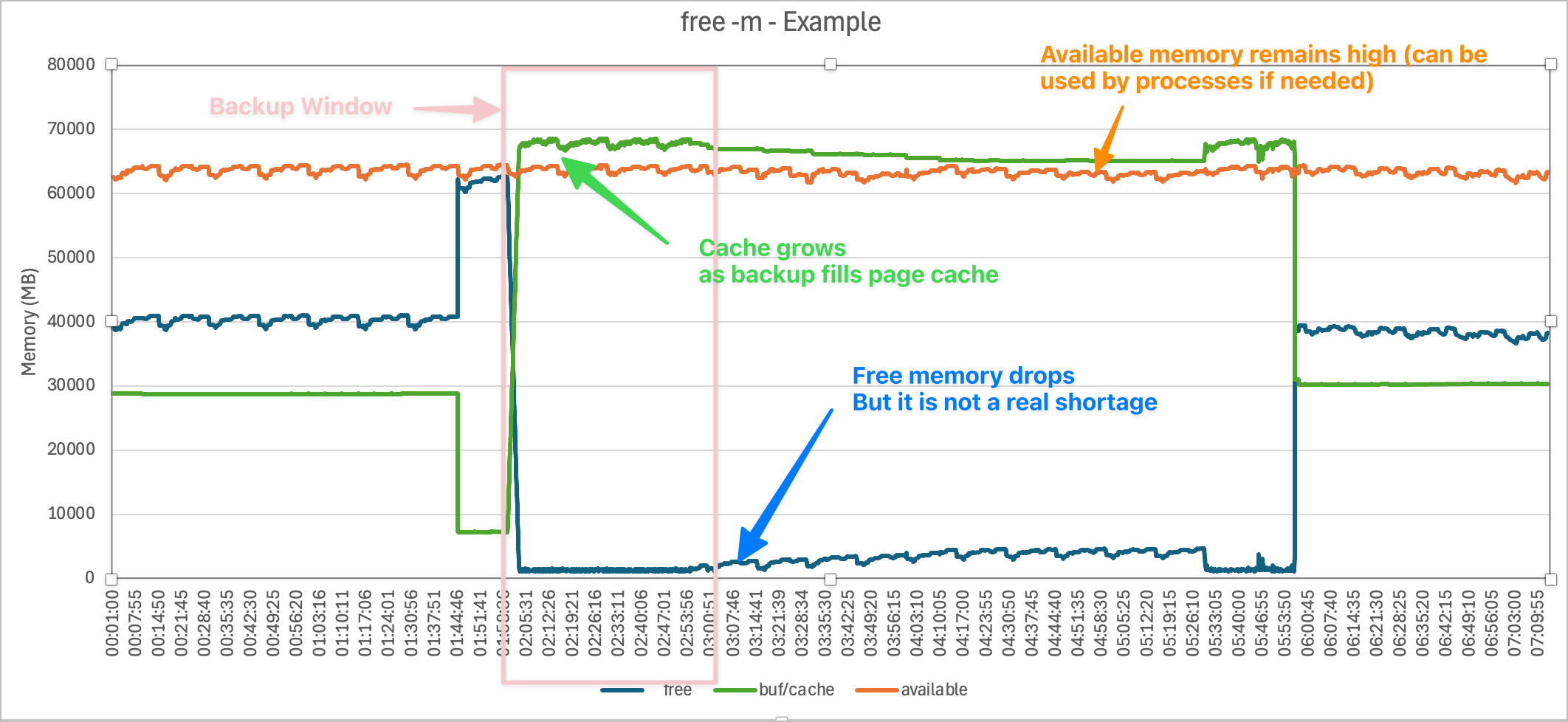
image

Although free drops near zero during the backup, available remains much higher (tens of GB). That means the system could provide that memory to processes if needed.

Where do huge pages appear in free?

By default, free -m does not show huge pages directly. To see them, you need /proc/meminfo entries like HugePages_TotalHugePages_Free, and Hugepagesize.

Because the OS reserves huge pages at startup, they are effectively invisible to free -m. They are locked away from the general memory pool.

Summary

  • The low "free memory" seen around 02:00 is caused by the Linux page cache being filled by backup reads. This is expected behaviour and does not indicate a memory shortage.
  • Huge pages reserved for IRIS are unaffected and continue serving the database efficiently.
  • The actual memory available to applications is best measured by the available column, which shows the system still has sufficient headroom.

But wait, what about if I don't use Huge Pages?

It is common not to use Huge Pages on non-production or systems with limited memory -- performance gains of Huge Pages are usually not significant under 64 GB, although it is still best practice to use Huge Pages to protect IRIS shared memory.

Sidebar. I have seen sites get into trouble by allocating Huge Pages smaller than shared memory, which causes IRIS to try and start with very small global buffers or fail to start if memlock is used (consider memlock=192 for production systems).

Without Huge Pages, IRIS shared memory segments (globals, routines, gmheap, etc.) are allocated from normal OS memory pages. This would show up under “used” memory in free -m. It would also contribute to “available” going lower, because that memory can’t easily be reclaimed.

  • used – Much higher, reflecting IRIS shared memory + kernel + other processes.
  • free – Likely lower, because more RAM is permanently allocated to IRIS in the regular pool.
  • buf/cache – Would still rise during backups, but the apparent headroom for processes would look tighter because IRIS memory is in the same pool.
  • available – Closer to the true “free + reclaimable cache” minus IRIS memory. This would look smaller than in your Huge Pages setup.

So, should you use Huge Pages on production systems?

YES!

For memory protection. IRIS shared memory is protected from:

  • Swap out during memory pressure.
  • Competition with filesystem operations like backups and file copies, as we have seen in this example.

Other notes - into the weeds...

How is the data collected?

The command used in ^SystemPerformance for a 24-hour collection (17280 seconds) with 5 second tick is:

free -m -s 5 -c 17280 | awk '{now=strftime(""%m/%d/%y %T""); print now "" "" $0; fflush()}' > ","/filepath/logs/20250315_000100_24hours_5sec_12.log

2
7 172
Article Harshitha · Oct 22, 2025 2m read

Hello community,

I wanted to share my experience about working on Large Data projects. Over the years, I have had the opportunity to handle massive patient data, payor data and transactional logs while working in an hospital industry. I have had the chance to build huge reports which had to be written using advanced logics fetching data across multiple tables whose indexing was not helping me write efficient code.

Here is what I have learned about managing large data efficiently.

Choosing the right data access method.

As we all here in the community are aware of, IRIS provides multiple ways to access data. Choosing the right method, depends on the requirement.

  • Direct Global Access: Fastest for bulk read/write operations. For example, if i have to traverse through indexes and fetch patient data, I can loop through the globals to process millions of records. This will save a lot of time.
Set ToDate=+HSet FromDate=+$H-1ForSet FromDate=$O(^PatientD("Date",FromDate)) Quit:FromDate>ToDate  Do
. Set PatId=""ForSet PatId=$Order(^PatientD("Date",FromDate,PatID)) Quit:PatId=""Do
. . Write$Get(^PatientD("Date",FromDate,PatID)),!
  • Using SQL: Useful for reporting or analytical requirements, though slower for huge data sets.
6
1 102
Question Scott Roth · Oct 22, 2025

I am looking for a way to capture Data Quality issues with the Source data that is populating HealthShare Provider Directory. 1 way is to use Managed Alerts, but since it could be multiple Providers and different messages it seems silly to alert on every message that has the error. Instead, I was thinking of using the Workflow Engine so it could populate a Worklist for someone to review and work.

Looking over the Demo.Workflow Engine example, I am not comprehending on how to send a task to the Workflow manager to populate the worklist from a DTL.

1
0 33
Article Vachan C Rannore · Oct 21, 2025 3m read

Hello!!!

Data migration often sounds like a simple "move data from A to B task" until you actually do it. In reality, it is a complex process that blends planning, validation, testing, and technical precision.

Over several projects where I handled data migration into a HIS which runs on IRIS (TrakCare), I realized that success comes from a mix of discipline and automation.

Here are a few points which I want to highlight.

1. Start with a Defined Data Format.

Before you even open your first file, make sure everyone, especially data providers, clearly understands the exact data format you expect. Defining templates early avoids unnecessary bank-and-forth and rework later. 

While Excel or CSV formats are common, I personally feel using a tab-delimited text file (.txt) for data upload is best. It's lightweight, consistent, and avoids issues with commas inside text fields. 

PatID   DOB Gender  AdmDate
10001   2000-01-02  M   2025-10-01
10002   1998-01-05  F   2025-10-05
10005   1980-08-23  M   2025-10-15

Make sure that the date formats given in the file is correct and constant throughout the file because all these files are usually converted from an Excel file and an Basic excel user might make mistakes while giving you the date formats wrong. Wrong date formats can irritate you while converting into horolog.

8
1 103
Discussion Yone Moreno Jiménez · Aug 1, 2025

Hello InterSystems Community,

I hope you're all doing well. I'm reaching out to ask if there's any way to enable a dark theme or dark mode for the HealthShare Management Portal.

Background

I have a visual impairment (amblyopia/lazy eye) which means I'm nearly blind in one eye. Like many people with visual difficulties, I find that bright white backgrounds and interfaces cause significant eye strain and fatigue. This makes it challenging to work with the Management Portal for extended periods.

What I've Found So Far

8
0 171
Article Vachan C Rannore · Sep 15, 2025 2m read

Starting out with ObjectScript, it is really exciting, but it can also feel a little unusual if you're used to other languages. Many beginners trip over the same hurdles, so here are a few "gotchas" you'll want to watch out for. (Also few friendly tips to avoid them)

NAMING THINGS RANDOMLY

We have all been guilty of naming something Test1 or MyClass just to move on quickly. But once your project grows, these names become a nightmare. 

➡ Pick clear, consistent names from the start. Think of it as leaving breadcrumbs for your future self and your teammates.

MIXING UP GLOBALS AND VARIABLES

15
2 280
Question Mary George · Oct 8, 2025

Hi Team, 

Can I please check if anyone has built a simple web interface for maintaining custom SQL lookup class.   

We have a simple persistent class in HealthShare which is used for storing Pathology test codes. Test codes in this lookup class is used for message filtering and applying additional logic when processing pathology results/orders. 

We want to make this class available to external users from pathology (not the usual management portal users) to maintain so that they can add/edit/delete test codes as required. 

2
0 74
Article Sanjib Pandey · Oct 17, 2025 13m read

Overview

This web interface is designed to facilitate the management of Data Lookup Tables via a user-friendly web page. It is particularly useful when your lookup table values are large, dynamic, and frequently changing. By granting end-users controlled access to this web interface (read, write, and delete permissions limited to this page), they can efficiently manage lookup table data according to their needs.

The data managed through this interface can be seamlessly utilized in HealthConnect rules or data transformations, eliminating the need for constant manual monitoring and management of the lookup tables and thereby saving significant time.

Note:
If the standard Data Lookup Table does not meet your mapping requirements, you can create a custom table and adapt this web interface along with its supporting class with minimal modifications. Sample class code is available upon request.

0
1 59
Article Ariel Glikman · Feb 11, 2025 5m read

The Istio Service Mesh is commonly used to monitor communication between services in applications. The "battle-tested" sidecar mode is its most common implementation. It will add a sidecar container to each pod you have in your namespace that has Istio sidecar injection enabled.

It's quite easy to get started with, just put the istioctl executable in your PATH, and label your namespace such that it tells Istio to acitvate side car injection there.

3
2 319
Article John Murray · Oct 6, 2025 1m read

gj :: configExplorer is a new VS Code extension integrating with Server Manager and leveraging Structurizr to produce configuration diagrams of your servers.

Here's a short introductory video.

By using the InterSystems IRIS Native API for Node.js it avoids the need for any support code to be installed on the servers. This technology choice also qualifies it for entry into the current Developer Community contest.

The initial release focuses on two aspects of server configuration:

  • Namespaces and databases
  • ECP connectivity

Suggestions for what to add next are welcome, as is general feedback.

6
0 104
Question Scott Roth · Oct 13, 2025

I have a custom defined priority field that is being stored as a number type

<record name="LocalClinicalMeSHTerms" type="serial">
<field name="LocalClinicalExpertiseCodedValue" type="{CODETYPE}" codeFamily="HSPD" codeTable="LocalClinicalExpertise" codeScheme="{MASTER}"/>
<field name="LocalCliniclDisplayOrder" type="number"/>
</record>

However, within the overviewIndividual.cls form

0
0 37
Article Enzo Medina · Oct 10, 2025 9m read

Deploying new IRIS instances can be a time-consuming task, especially when setting up multiple environments with mirrored configurations.

I’ve encountered this issue many times and want to share my experience and recommendations for using Ansible to streamline the IRIS installation process. My approach also includes handling additional tasks typically performed before and after installing IRIS.

2
3 72
Article John Murray · Oct 9, 2025 2m read

In my previous article introducing gj :: configExplorer I flagged up how an apparent bug in the Windows elements of the Native API for Node.js means it's not currently available to run in VS Code on a Windows desktop. In a comment on that article I offered a workaround, but this requires a Docker-equipped Linux host you can SSH to.

If you don't have a suitable target it's now possible to leverage your local Windows Docker Desktop. Here's how:

  1. Open a new VS Code window.
1
0 39
Article Ariel Glikman · Sep 16, 2025 14m read

One of the recommendations when deploying InterSystems Technologies for production is to set up High Availability. The recommended API Manager for these InterSystems Technologies is the InterSystems API Manager (IAM). IAM (essentially Kong Gateway) has multiple deployment topologies.

If you are looking for high availability you could use:

a) Kong Traditional Mode: Multiple Node Clusters

b) Hybrid Mode

c) DB-less Mode

Before we break them down let's first understand the out of the box deployment that is provided by InterSystems: Installing IAM Version 3.10.

Kong Traditional Mode

2
3 112