g sdgfh sdgh sdsgh

InterSystems Ensemble is a complete and easy-to-use integration platform that enables users to connect people, processes, and applications in record
time.
InterSystems Ensemble is a complete and easy-to-use integration platform that enables users to connect people, processes, and applications in record
time.
g sdgfh sdgh sdsgh
Is there any way of saving a representation of the results of a query created in the Message Viewer to a file - most obviously CSV.
We are reasonably adept at creating queries. We'd like to be able to send the output to a file, rather than resorting to cut'n'pasting from the message viewer window...
Is this possible? (on any version of Ensemble/Iris?)
Desired output to file something like:
ID,TimeCreated,Session,Status,Error,Source,Target,Body_MSH_MessageControlId,.....
1,8888888,2025-08-20 05:03:14.324,8438123,Completed,OK,ICE ADT Validator,ICE ADT TCP,1z123456,20220822......
Hi Guys,
I'm a newbie in term of MQTT clients & brokers, and I've created a MQTT adapter to connect to a broker and I asked our system admin for the user/pass and the URL and this where we got stuck.
The admin is saying that all he has is IP address to the PEM key to the server itself, so my question is, is the broker the server itself and the url is the url to the server or is the Broker an application (eg. Mosquito) that runs in a server and if that's the case and if its Mosquito, where do I find the connection details to it (user/pass & URL) ?
Thanks
Thanks
The Interoperability user interface now includes modernized user experiences for the DTL Editor and Production Configuration applications that are available for opt-in in all interoperability products. You can switch between the modernized and standard views. All other Interoperability screens remain in the Standard user interface. Please note that changes are limited to these two applications and we identify below the functionality that is currently available.
When exporting using the Export() method of the %Library.Global class, if the export format (fourth argument: OutputFormat) is set to 7, "Block format/Caché block format (%GOF)," mapped globals cannot be exported (only globals in the default global database of the namespace are exported). To export mapped globals in "Block format/Caché block format (%GOF)," specify the database directory to which you want to map them in the first parameter of %Library.Global.Export().
An example of execution is shown below.
Hi,
I have just installed WebTerminal on my local instance of Health Connect 2025.1, but it does not work and returns a HTTP 401 error.
Can any one help, as I have never installed WebTerminal before?
Has there been any changes in Health Connect to stop it working in version 2025.1?
Thanks.
Neil
Hello
This article follows up on the question I had asked the community UDP Adapter not working
In this article, I will present to you
1) What is "UDP"?
2) The current state of Iris with UDP
3) My solution with the UDP adapter
UDP stands for User Datagram Protocol. It is one of the core protocols of the Internet Protocol (IP) suite, used for transmitting data over a network. Here are some key features of UDP:
Hello,I am currently facing the task of retrieving or sending HL7 messages from a web API. Since we only send HL7 messages via internal sockets, web APIs are relatively new to me.The following is my plan for the new interface:I have created a new custom business service that periodically sends requests to a business process. In this business process, the HTTP request (HTTP.GenericMessage) is then created from scratch. The special feature is the "Authorisation" header field, where a signature is inserted, which consists of a base64-encoded hash value. The request is then sent to the API via a
Am also asking this question on the extension's GitHub page: Request textDocument/documentSymbol failed. Error: name must not be falsy · intersystems-community/vscode-objectscript · Discussion #1530 - but suspect more eyes will see it here, which might help gather additional information.
Tried to compile some legacy ObjectScript code via Import/Compile in VS Code using the vscode-objectscript extension. Getting an error, and the content of the file is left changed on the filesystem simply by being compiled.
In Ensemble->Enterprise Portal->Message Bank Viewer ,the Search option based on basic or extended criteria is not working.Please can somebody answer why so?
Hi,
I’m working in Ensemble and trying to resend a message from the Message Viewer. The message is in XML format.
When I try to edit the XML before resending,
.png)
I’m looking for guidance on:
Any suggestions or examples would be very helpful.
I am regularly contacted by customers about memory sizing when they get alerts that free memory is below a threshold, or they observe that free memory has dropped suddenly. Is there a problem? Will their application stop working because it has run out of memory for running system and application processes? Nearly always, the answer is no, there is nothing to worry about. But that simple answer is usually not enough. What's going on?
Consider the chart below. It is showing the output of the free metric in vmstat. There are other ways to display a system's free memory, for example, the free -m command. Sometimes, free memory will gradually disappear over time. However, the chart below is an extreme example, but it is a good example to illustrate what's going on.

As you can see, at around 2 am, some memory is freed, then suddenly drops close to zero. This system is running the IntelliCare EHR application on the InterSystems IRIS database. The vmstat information came from a ^SystemPerformance HTML file that collects vmstat, iostat and many other system metrics. What else is going on on this system? It is the middle of the night, so I don't expect much is happening in the hospital. Let's look at iostat for the database volumes.

There is a burst of reads at the same time as the free memory drops. The drop in reported free memory aligns with a spike in large block-sized reads (2048 KB request size) shown in iostat for the database disk. This is very likely a backup process or file copy operation. Ok, so correlation isn't causation, but this is worth looking at, and it turns out, explains what's going on.
Let's look at some other output from ^SystemPerformance. The command free -m is run at the same rate as vmstat (for example, every 5 seconds), and is output with a date and time stamp, so we can also chart the counters in free -m.
The counters are:
free -m.Low free memory is not a shortage, but rather the system utilising "free" memory for caching. This is normal Linux behaviour! The backup process is reading large amounts of data, which Linux aggressively caches in the buffer/cache memory. The Linux kernel converts "free" memory into "cache" memory to speed up I/O operations.
The filesystem cache is designed to be dynamic. If a process requires memory, it will be immediately reclaimed. This is a normal part of Linux memory management.
For performance and to reserve memory for IRIS shared memory, the best practice for production IRIS deployments on servers with large memory is to use Linux Huge Pages. For IntelliCare, a rule of thumb I use is to use 8 GB memory per core and around 75% of memory for IRIS shared memory -- Routine and Global buffers, GMHEAP, and other shared memory structures. How shared memory is divided up depends on application requirements. Your requirements could be completely different. For example, using that CPU to memory ratio, is 25% enough for your application IRIS processes and OS processes?
InterSystems IRIS uses direct I/O for database and journal files, which bypasses the filesystem cache. Its shared memory segments (globals, routines, gmheap, etc.) are allocated from Huge Pages.
free -m.This explains why the free -m metrics look "low" even though the IRIS database itself is not starved of memory.
From above, in free -m, the relevant lines are:
Available is a good indicator — it includes reclaimable cache and buffers, showing what’s actually available for new processes without swapping. What processes? For a review, have a look at InterSystems Data Platforms and Performance Part 4 - Looking at Memory . A simple list is: Operating system, other non-IRIS application processes, and IRIS processes.
Let's look at a chart of the free -m output.
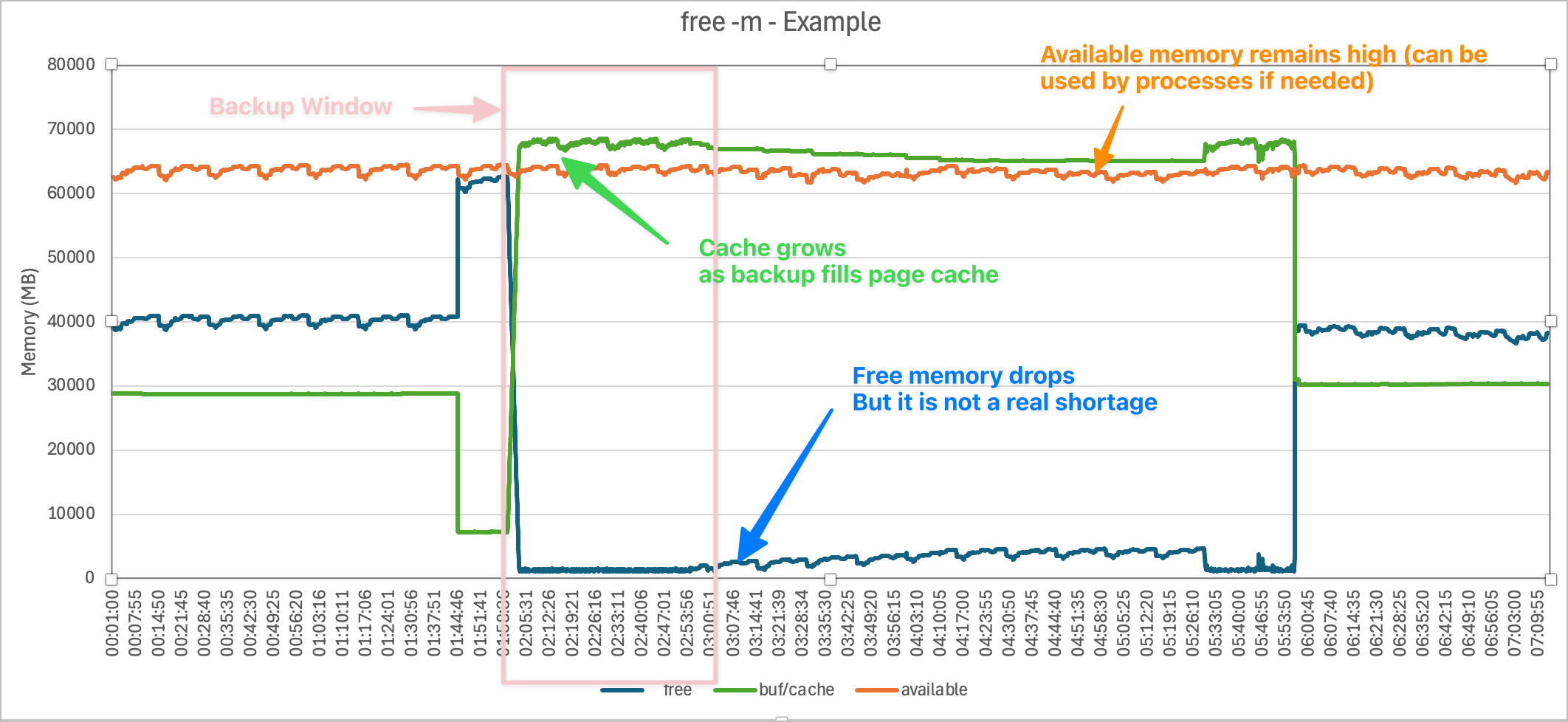
Although free drops near zero during the backup, available remains much higher (tens of GB). That means the system could provide that memory to processes if needed.
By default, free -m does not show huge pages directly. To see them, you need /proc/meminfo entries like HugePages_Total, HugePages_Free, and Hugepagesize.
Because the OS reserves huge pages at startup, they are effectively invisible to
free -m. They are locked away from the general memory pool.
available column, which shows the system still has sufficient headroom.It is common not to use Huge Pages on non-production or systems with limited memory -- performance gains of Huge Pages are usually not significant under 64 GB, although it is still best practice to use Huge Pages to protect IRIS shared memory.
Sidebar. I have seen sites get into trouble by allocating Huge Pages smaller than shared memory, which causes IRIS to try and start with very small global buffers or fail to start if memlock is used (consider memlock=192 for production systems).
Without Huge Pages, IRIS shared memory segments (globals, routines, gmheap, etc.) are allocated from normal OS memory pages. This would show up under “used” memory in free -m. It would also contribute to “available” going lower, because that memory can’t easily be reclaimed.
YES!
For memory protection. IRIS shared memory is protected from:
The command used in ^SystemPerformance for a 24-hour collection (17280 seconds) with 5 second tick is:
free -m -s 5 -c 17280 | awk '{now=strftime(""%m/%d/%y %T""); print now "" "" $0; fflush()}' > ","/filepath/logs/20250315_000100_24hours_5sec_12.log
Hi all,
Recently we were experimenting with having a variable target on a routing rule and noticed some interesting behaviour, code below.
<rulename="My Rule"disabled="false"><constraintname="docCategory"value="Generic.2.3.1"></constraint><whencondition="((Document.{MSH:MessageType.triggerevent}="A43"))"><sendtransform=""target="To" _(pContext.Document.GetValueAt("MSH:SendingFacility"))_"FromServiceTCPOpr"></send></when></rule>Starting out with ObjectScript, it is really exciting, but it can also feel a little unusual if you're used to other languages. Many beginners trip over the same hurdles, so here are a few "gotchas" you'll want to watch out for. (Also few friendly tips to avoid them)
NAMING THINGS RANDOMLY
We have all been guilty of naming something Test1 or MyClass just to move on quickly. But once your project grows, these names become a nightmare.
➡ Pick clear, consistent names from the start. Think of it as leaving breadcrumbs for your future self and your teammates.
MIXING UP GLOBALS AND VARIABLES
This web interface is designed to facilitate the management of Data Lookup Tables via a user-friendly web page. It is particularly useful when your lookup table values are large, dynamic, and frequently changing. By granting end-users controlled access to this web interface (read, write, and delete permissions limited to this page), they can efficiently manage lookup table data according to their needs.
The data managed through this interface can be seamlessly utilized in HealthConnect rules or data transformations, eliminating the need for constant manual monitoring and management of the lookup tables and thereby saving significant time.
Note:
If the standard Data Lookup Table does not meet your mapping requirements, you can create a custom table and adapt this web interface along with its supporting class with minimal modifications. Sample class code is available upon request.
gj :: configExplorer is a new VS Code extension integrating with Server Manager and leveraging Structurizr to produce configuration diagrams of your servers.
Here's a short introductory video.
By using the InterSystems IRIS Native API for Node.js it avoids the need for any support code to be installed on the servers. This technology choice also qualifies it for entry into the current Developer Community contest.
The initial release focuses on two aspects of server configuration:
Suggestions for what to add next are welcome, as is general feedback.
I'm trying to make a connection to an external database using %SQLGatewayConnection, but the connection always fails. DSN properly configured. I try to make the same connection through isql in bash, and the connection is successful.
This same connection fails in Caché.
Some languages have the concept of a garbage collector for automatic memory management. I'd like to know if something like this exists in InterSystems Caché in the context of routines, %CSP.REST, or %CSP.Page.
The question arises from the %Close() method of the %RegisteredObject class. This indicates that I need to manually clear the object from memory if it's no longer in use, or in the web context, if the request has completed. Is this correct? Or am I completely wrong?
Thank you!
To manage the accumulation of production data, InterSystems IRIS enables users to manage the database size by periodically purging the data. This purge can apply to messages, logs, business processes, and managed alerts.
Please check the documentation for more details on the settings of the purge task:
https://docs.intersystems.com/irislatest/csp/docbook/DocBook.UI.Page.cls?KEY=EGMG_purge#EGMG_purge_settings
This code provide the configured production items with enabled or disabled status.
Include (Ensemble, EnsUI, EnsUtil)
Class Test.ProductionConfig
{
In my previous article introducing gj :: configExplorer I flagged up how an apparent bug in the Windows elements of the Native API for Node.js means it's not currently available to run in VS Code on a Windows desktop. In a comment on that article I offered a workaround, but this requires a Docker-equipped Linux host you can SSH to.
If you don't have a suitable target it's now possible to leverage your local Windows Docker Desktop. Here's how:
For historic reasons we've got a mix of ADT feeds coming out of our PAS (TrakCare) to a wide range of downstream systems. In particular, there are some that are direct from TrakCare to the downstream systems, and many more that pass through Ensemble as our integration engine.
This is complicating management of the integrations, and so we'd like everything to go through the integration engine. In other words move from the flow in the top of the diagram to the flow in the bottom of the diagram:
When we need to integrate Caché/IRIS with other relational databases, one common question arises: “How do I set up the JDBC connection?”.
The official documentation doesn’t always provide a straightforward step-by-step guide, which can be frustrating, especially for beginners.
In this article, I’ll walk you through the entire process of configuring a JDBC connection with MySQL, from downloading the connector to linking tables in Caché/IRIS.
InterSystems FAQ rubric
The ^%GCMP utility can be used to compare the contents of two globals.
For example, to compare ^test and ^test in the USER and SAMPLES namespaces, it would look like this:
*In the example below, 700 identical globals are created in the two namespaces, and the contents of one of them is changed to make it the detection target.
I'm trying to access the Bearer token from the Authorization header in my REST service class, but I'm getting a 500 Internal Server Error when I try to use %request.GetCgiEnv("HTTP_AUTHORIZATION").
My Environment:
EnsLib.REST.Service with HTTP Inbound Adapterhttp://ip:port/api-kiosk/patientDataMy Code:
objectscript
HL7 messages often contain multiple repeating segments such as NTE, AL1, OBX, ZTX, DG1, and others. These segments sometimes require individual processing and routing to different downstream systems. This technical paper introduces a configurable template designed to automate the splitting of these repeating HL7 segments, improving message handling and integration efficiency.
The utility returns the desired values from the text and display the multiple values if exists based on starting and ending string.
Class Test.Utility.FunctionSet Extends %RegisteredObject
{
/// W !,##class(Test.Utility.FunctionSet).ExtractValues("Some random text VALUE=12345; some other VALUE=2345; more text VALUE=345678;","VALUE=",";")
InterSystems FAQ rubric
One way to optimize query performance is to use query parallelism on a per-query or system-wide basis (a standard feature).
This is a technique for dividing the execution of a particular query among processors on a multi-processor system. The query optimizer will execute parallel processing only if there is a possibility of benefiting from parallel processing. Parallel processing is only applicable to SELECT statements.
Our vendor is developing an interface API on their end to capture HL7 data on a Server Port, and they require us to send a pre-defined HL7 Order message for testing every hour until the API is completely operational.
Is it possible to accomplish that in a Business Operation automatically without utilizing a service or process? The BO is a standard TCP/IP connection.
I'm manually sending the message again from the Operations right now. I do not have access to the System Operation to use the Task Manager feature.
Hi Team,
I've basic learning in Ensemble. I want to create a code as per following request. Please help in clearing following questions
We have a business process-AA. In this business process, we have onRequest method, here after performing some logic, I have to call a method ProcessAAlogic.