#Contest

0 Followers · 412 Posts

Contest tag unites posts that are related to any coding competition taking place on InterSystems Developer Community.

Announcement Anastasia Dyubaylo · Nov 6, 2025

Hi Developers,

Following the resounding success of last year's new contest, we decided to repeat it. Please welcome 

🏆 Bringing Ideas to Reality Contest 🏆

Submit an application that implements an idea from the InterSystems Ideas Portal that has status Community Opportunity or Future Consideration, created before the publication of this announcement, and requires doing the actual programming 😉

Duration: November 17 - December 7, 2025

Prize pool: $12,000


0
0 72
Article Corentin Blondeau · Feb 24, 2025 4m read

Hello
This article follows up on the question I had asked the community UDP Adapter not working
In this article, I will present to you
1) What is "UDP"?
2) The current state of Iris with UDP
3) My solution with the UDP adapter


1) What is "UDP"?

UDP stands for User Datagram Protocol. It is one of the core protocols of the Internet Protocol (IP) suite, used for transmitting data over a network. Here are some key features of UDP:

4
4 257
Article Julio Esquerdo · Feb 14, 2025 5m read

HTTP and HTTPS with REST API

Hello

The HTTP protocol allows you to obtain resources, such as HTML documents. It is the basis of any data exchange on the Web and a client-server protocol, meaning that requests are initiated by the recipient, usually a Web browser.

REST APIs take advantage of this protocol to exchange messages between client and server. This makes REST APIs fast, lightweight, and flexible. REST APIs use the HTTP verbs GET, POST, PUT, DELETE, and others to indicate the actions they want to perform.

When we make a call to a RESt API, what actually happens is an HTTP call. The API receives this call and according to the requested verb and path, the API performs the desired action. In the case of the Iris implementation we can see this clearly in the URLMap definition area:

1
3 377
Article Pietro Di Leo · Oct 6, 2025 4m read
2
0 73
Article Pietro Di Leo · Oct 6, 2025 5m read

Hi everyone! 👋
I’m excited to share the project I’ve submitted to the current InterSystems .Net, Java, Python, and JavaScript Contest — it’s called IRIStool and Data Manager, and you can find it on the InterSystems Open Exchange and on my GitHub page.

1
2 67
Announcement Irène Mykhailova · Sep 23, 2025

Hi Community!

We are excited to announce the new French technical article writing contest!

✍️ Technical Article Contest ✍️

This is the perfect opportunity for all InterSystems technology enthusiasts to share their knowledge and showcase their writing skills. No matter your experience level, everyone is welcome to participate. Articles can cover a wide range of topics, from technical implementation to your impressions and feedback on using InterSystems products or services. So let your creativity and expertise run wild!

📅 Contest period: September 15 - November 30, 2025 (extended!)

🎁 Gifts for all: a special gift is prepared for each participant!

🏅 Prizes for the authors of the best articles

<--break->

0
0 63
Announcement Anastasia Dyubaylo · Sep 15, 2025

Hi Community,

We're super excited and thankful to our 52 InterSystems colleagues who participated in the 📺 Demo Games for InterSystems Sales Engineers 📺 and created 19 amazing videos.

Our colleagues worldwide put their creativity, technical know-how, and demo magic to the test. What started as an internal contest to showcase technical skill and demo excellence became a true stage for imagination with some entries looking less like demos and more like short films, complete with acting, storytelling, and even a cinematic touch.

Also, we'd like to thank all the members of the Community who took the time to watch them and vote for their favourites! 

And now it's time to announce the winners!

9
1 292
Article Laurel James (GJS) · Mar 12, 2024 2m read

SQLTools is a Visual Studio Code (VS Code) Extension with over 3.5 million downloads that provides connections to many of the most used databases, including InterSystems IRIS, using drivers. For developers new to VS Code, or those already familiar with it but are looking to streamline their connections to InterSystems IRIS, this tutorial will take you through installing the SQLTools extensions and the InterSystems IRIS drive. It then guides you on how to establish a connection to your instance of InterSystems IRIS and run a query. You will need: VS Code installed on your system and access to

2
4 819
Article Henry Pereira · Jul 31, 2025 5m read

artisan cover

If you’ve ever watched a true artisan—whether a potter turning mud into a masterpiece or a luthier bringing raw wood to life as a marvelous guitar—you know that magic isn’t in the materials, but in care, craft, and process. I know this firsthand: my handmade electric guitar is a daily inspiration, but I’ll admit—creating something like that is a talent I don’t have.

Yet, in the digital world, I often see people hoping for “magic” from generative AI by typing vague, context-free prompts like “build an app.” The results are usually frustratingly shallow—no artistry, no finesse. Too many expect AI to work miracles with zero context or structure. That frustration is what motivated us to build dc-artisan—a tool for digital prompt artisans. Our goal: to enable anyone to transform rough, wishful prompts into efficient, functional, and context-rich masterpieces.

Like watching a master artisan transform raw materials into art, creating with GenAI is about intent, preparation, and thoughtful crafting. The problem isn’t with AI itself—it’s how we use it. Just as a luthier must carefully select and shape each piece of wood, effective prompt engineering demands clear context, structure, and intention.

We believe the world deserves more than “magical prompts” that lead to disappointment. Powerful generative AI arises from thoughtful human guidance: precise context, real objectives, and deliberate structure. No artisan creates beauty by accident—reliable AI outputs require care and preparation.

dc-artisan approaches prompt engineering as a true craft—systematic, teachable, and testable. It offers a comprehensive toolkit for moving beyond trial, error, and guesswork.

The first thing dc-artisan does is aim to understand your prompt the way a thoughtful collaborator would. When you begin drafting, the tool engages directly with your input:

  • Clarifying questions: dc-artisan analyzes your initial prompt and asks focused questions to uncover your core objective, target audience, expected format, and any missing context. For example:
    • “What kind of output are you expecting—text summary, code, or structured data?”
    • “Who is the target audience?”
    • “What type of input or data will this prompt be used with?”

prompt enhance

These interactions help you clarify not just what you want the prompt to say, but also why.

Once your intent is clear, dc-artisan reviews the structure and offers tailored suggestions—enhancing clarity, improving tone, and filling in missing details critical for context-rich, actionable output.

And the best thing? You use all these features right inside your beloved editor, VS Code! You can insert variables directly in your prompt (like {task} or {audience}) for flexibility and reuse, instantly previewing how final prompts look with different substitutions—so you see exactly how it will work in practice.

But that’s not all. dc-artisan supports prompt tuning for optimal performance. Upload a CSV of test cases to automatically evaluate consistency, output quality, and the impact of your prompt structure across varied inputs. dc-artisan evaluates each response and generates comprehensive reports with quality scores and similarity metrics—so you can measure and optimize your prompts’ effectiveness with confidence.
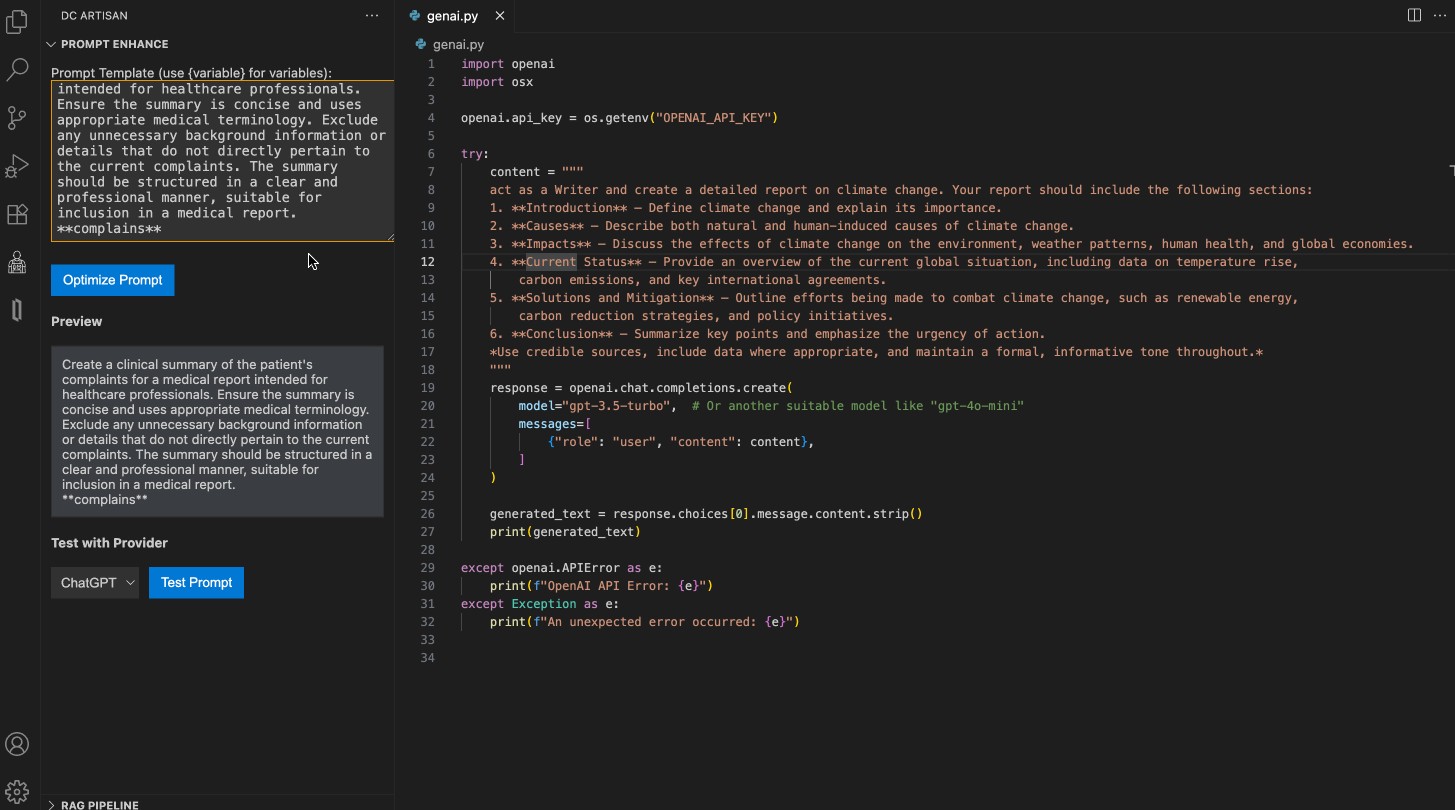
testing

Prompting Without Context Isn’t Craft — It’s Chaos

Prompt engineering without structure is like carving wood blindfolded. You might produce something, but it likely won’t play a tune.

Many resort to vague or overloaded prompts—short, ambiguous commands or pages of raw content without structure. Either the model has no real idea what you want, or it’s lost in a swamp of noise.

When a prompt’s context becomes too long or cluttered, even advanced LLMs can lose focus. Instead of reasoning or generating new strategies, they often get distracted, repeating earlier content or sticking to familiar patterns from the beginning of your prompt history. Ironically, larger models with bigger context windows (like 32k tokens) are even more susceptible to this. Simply providing more context (more documents, bigger prompts, entire knowledge bases) frequently backfires, resulting in context overload, missed objectives, and confused outputs.

That’s precisely the gap that RAG (Retrieval-Augmented Generation) is designed to fill: not by giving LLMs more information, but by feeding them the most relevant knowledge at the right moment.

How dc-artisan and RAG Pipeline Mode Help

dc-artisan unifies prompt crafting and context management. It doesn’t just help you write better prompts; it ensures your AI receives curated, relevant information, not a tidal wave of trivia.

With RAG Pipeline Mode, you can:

  • 📄 Upload & Chunk Documents: PDF, DOCX, Markdown, TXT—easily embedding into your vector database.
  • 🧬 Inspect Chunks: View each atomic unit of embedded text with precision.
  • 🗑️ Smart Cleanup: Delete unwanted or outdated content directly from the extension, keeping your AI’s knowledge base curated and relevant.

rag

This workflow is inspired by the InterSystems Ideas Portal (see DPI-I-557)

Here’s how you can smoothly integrate a new section about dc-artisan’s backend architecture just before “Closing Thoughts,” highlighting the integration with InterSystems IRIS Interoperability and our custom liteLLM adapter.

What truly sets dc-artisan apart is its robust backend, engineered for both interoperability and flexibility. The extension’s engine runs on InterSystems IRIS Interoperability, utilizing a custom-built liteLLM adapter that we developed.

This architecture means you’re not locked into a single large language model (LLM) provider. Instead, you can seamlessly connect and switch between a wide range of leading LLM platforms—including OpenAI, Gemini, Claude, Azure OpenAI, and others—all managed from a unified, enterprise-grade backend.

Closing Thoughts

More developers are discovering that prompting isn’t about guessing the “magic words.” It’s about thoughtful goals, clear language, and powerful context—writing prompts like engineers, not wizards. Just as luthiers shape wood into instruments with soul, you can shape prompts into reliable, context-enriched AI workflows using tools crafted for your craft.

dc-artisan is more than a tool—it’s a mindset shift from vibe coding toward clarity, precision, and true digital artistry.

🎸 Ready to build prompts with your own hands?
⚙️ Fire up VS Code, install dc-artisan, and start crafting your AI like an artisan—not a magician.

🗳️ And if you like what we’ve built, vote for us in the InterSystems IRIS Dev Tools Contest—your support means a lot!

dc-artisan

2
0 88
Article John Murray · Jul 28, 2025 1m read

The new version of InterSystems Testing Manager which I released last week brings @Timothy Leavitt's cool 
Test Coverage Tool to VS Code, and is my entry for the 2025 Developer Tools contest.

Here's a teaser screenshot showing how the unit tests of the IPM project don't yet cover a feature that apparently allows an IPM repository to override its sort order.

1
0 86
Announcement John Murray · Jul 23, 2025

Users of the %UnitTest framework can now get test coverage information inside VS Code by combining the latest release (v2.0.0) of the InterSystems Testing Manager extension with @Timothy Leavitt's impressive Test Coverage Tool.

Above you can see the Test Coverage pane, which I have moved to the secondary sidebar on the right so it can more easily be explored in conjunction with the Test Explorer on the left.

0
0 80
Discussion Vadim Aniskin · Aug 15, 2023

Hi Developers!

There is a free ObjectScriptQuality tool for ObjectScript developers who upload solutions on GitHub. This tool helps developers validate ObjectScript code using a variety of rules, based on common code errors.

There are currently 16 rules in this tool, but there are definitely many more rules to consider when testing ObjectScript code.

Could you suggest any other rules to add to this tool?

13
0 503
Article Muhammad Waseem · May 28, 2025 4m read


Hi Community,
In this article, I will introduce my application iris-fhir-bridge 
IRIS-FHIR-Bridge is a robust interoperability engine built on InterSystems IRIS for Health, designed to transform healthcare data across multiple formats into FHIR and vice versa. It leverages the InterSystems FHIR Object Model (HS.FHIRModel.R4.*) to enable smooth data standardization and exchange across modern and legacy healthcare systems.

2
1 155
Article Laura Blázquez García · May 23, 2025 1m read


Let me introduce you to FHIRCraft, a lightweight tool to generate synthetic FHIR resources.

Now, you might be thinking:
“But wait — doesn’t Synthea already do that, and with tons of resources?”
Exactly — and that’s precisely why I created this app.

FHIRCraft is designed to generate simpler, smaller, and more focused FHIR resources. Unlike Synthea, it doesn’t aim to simulate entire patient histories or clinical workflows. Instead, it helps when you’re just getting started with FHIR — when you want to test things incrementally, or explore how specific resources behave in isolation.

2
2 151