Discussion Yone Moreno Jiménez · Aug 1, 2025

Hello InterSystems Community,

I hope you're all doing well. I'm reaching out to ask if there's any way to enable a dark theme or dark mode for the HealthShare Management Portal.

Background

I have a visual impairment (amblyopia/lazy eye) which means I'm nearly blind in one eye. Like many people with visual difficulties, I find that bright white backgrounds and interfaces cause significant eye strain and fatigue. This makes it challenging to work with the Management Portal for extended periods.

What I've Found So Far

8
0 171
Article Vachan C Rannore · Sep 15, 2025 2m read

Starting out with ObjectScript, it is really exciting, but it can also feel a little unusual if you're used to other languages. Many beginners trip over the same hurdles, so here are a few "gotchas" you'll want to watch out for. (Also few friendly tips to avoid them)

NAMING THINGS RANDOMLY

We have all been guilty of naming something Test1 or MyClass just to move on quickly. But once your project grows, these names become a nightmare. 

➡ Pick clear, consistent names from the start. Think of it as leaving breadcrumbs for your future self and your teammates.

MIXING UP GLOBALS AND VARIABLES

15
2 280
Article Developer Community Admin · Oct 21, 2025 7m read

Introduction

Businesses often use in-memory databases or key-value stores (caching layers) when applications require extremely high performance. However, in-memory databases incur a high total cost of ownership and have hard scalability limits, incurring reliability problems and restart delays when memory limits are exceeded. In-memory key-value stores share these limitations and introduce architectural complexity and network latency as well.

This article explains why InterSystems IRIS™ data platform is a superior alternative to in-memory databases and key-value stores for highperformance SQL and NoSQL applications.

Taking Performance and Efficiency to the Next Level

InterSystems IRIS is the only persistent database that can match or beat the performance of in-memory databases and caching layers for concurrent data ingestion and analytics processing. It can process incoming transactions, persist the data to disk, and index it for analytics in under one microsecond on commercially available hardware without introducing network latency.

The superior ingest performance of InterSystems IRIS results in part from its multi-dimensional data engine, which allows efficient and compact storage in a rich data structure. Using an efficient, multi-dimensional data model with sparse storage techniques instead of two-dimensional tables, random data access and updates are accomplished with very high performance, fewer resources and less disk capacity. It also provides in-memory, in-process APIs in addition to traditional TCP/IP access APIs to optimize ingest performance.

0
5 104
Question Adeel Nordin · Oct 20, 2025

Not sure where to ask for some helpful hints about IRIS 2019.1 in 2025, but here goes.

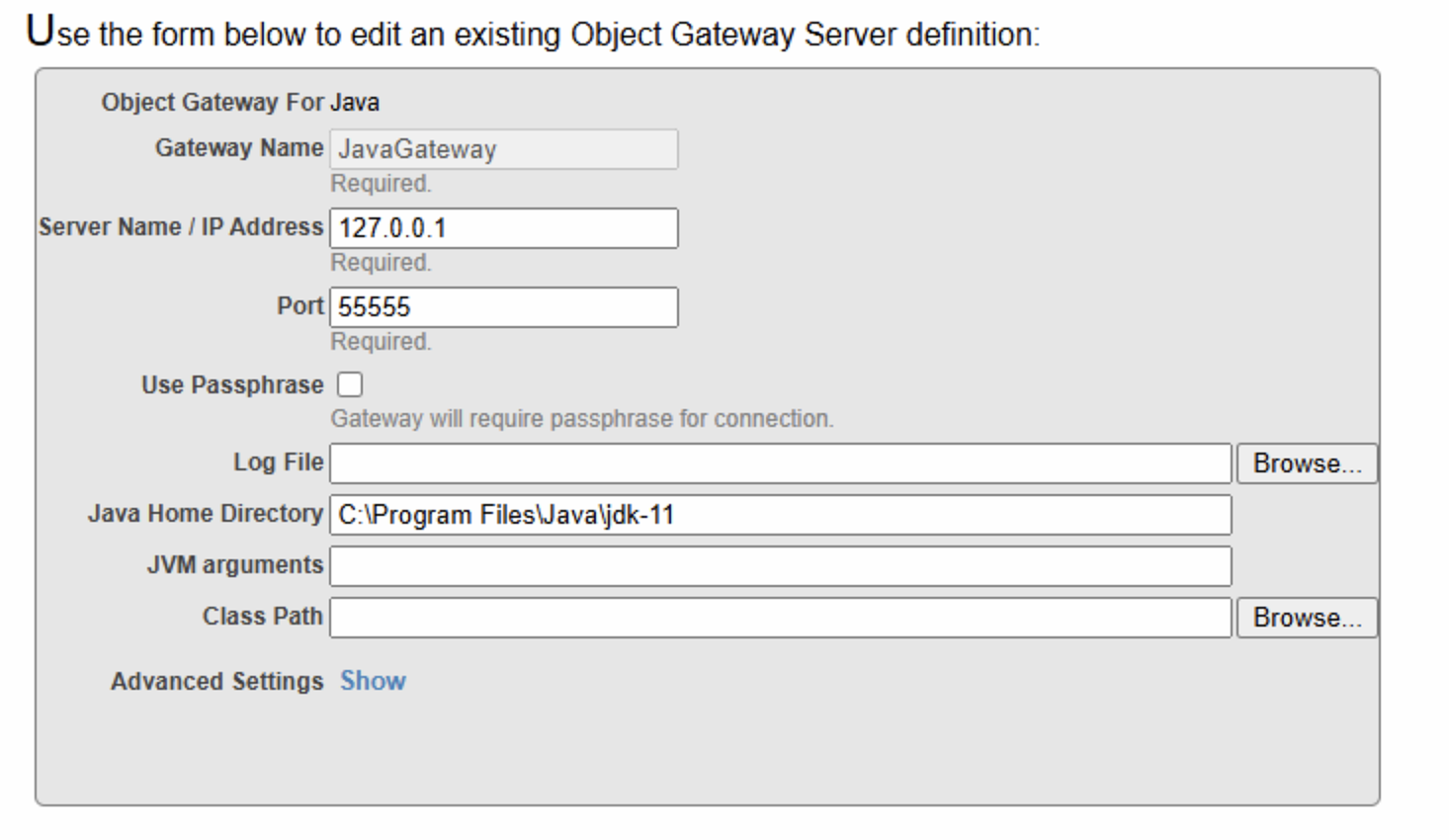
I'm trying to create a new Java gateway to run some Java code through ObjectScript, but I keep getting an error saying "Java executable not found in the given directory":

 This is my Object Gateway Server definition:

 I am not sure what is wrong, whether I am defining this gateway wrong, because I can verify that the executable exists in the provided directory.

Any help or hint is greatly appreciated!

2
0 45
Question Kurro Lopez · Oct 21, 2025

Hi community,

I have a service that uses EnsLib.RecordMap.Service.FTPService to capture files in an FTP directory.

Instead of uploading them all at once, I would need to do so one at a time.

I have a class that extends this class because it preprocesses, saves everything in the RecordMap class, and then processes all the records at once.

When I invoke the BP, it does so through the method set tStatus = ..SendRequest(message, 1).

I've set the SynchronousSend flag to 1, but it continues processing all the files at once.

1
0 35
Article Yuri Marx · Oct 2, 2024 14m read

In the modern world, the most valuable asset for companies is their data. Everything from business processes and applications to transactions is based on data which defines the success of the organization's operations, analysis, and decisions. In this scenario, the data structures need to be ready for frequent changes, yet in a managed and governed way. Otherwise, we will inevitably lose money, time, and quality of corporate solutions.For a long time, data management and governance were solely based on the data itself, with excellent backup, restoration, ACID (Atomicity, Consistency,

3
1 371
Question Mary George · Oct 8, 2025

Hi Team, 

Can I please check if anyone has built a simple web interface for maintaining custom SQL lookup class.   

We have a simple persistent class in HealthShare which is used for storing Pathology test codes. Test codes in this lookup class is used for message filtering and applying additional logic when processing pathology results/orders. 

We want to make this class available to external users from pathology (not the usual management portal users) to maintain so that they can add/edit/delete test codes as required. 

2
0 74
Article Robert Cemper · Oct 18, 2025 1m read

Being impressed by the graphics of the package GBLSizeMonitor  from @Ashok Kumar T 
I ask for his help, and this is the result of our cooperation.

As in the previous package, all is running from a CSP page.
And it is all classic CSP written with InterSystems ObjectScript, JavaScript, HTML
Besides the graphic, you also get concrete numbers freshly collected from your local
instance or from remote instances that also installed the package. 

The final result

The processing steps 

2
0 65
Article Pablo Frigolett · Mar 7, 2023 3m read

Surely you wanted to use the OpenAPI Specification (OAS) JSON you used for your spec class on the iris-web-swagger-ui iris package. The generated OAS from the ##class(%REST.API).GetWebRESTApplication(...) method is very crude, with no description on the parameters or the expected response structure.

So after creating your REST application from an OAS you should have:

  • A generated application.disp.cls class
  • An application.spec.cls class (we'll add a path to the OpenAPI spec that's residing in the "XData OpenAPI" property)
  • An application.impl.cls class (we'll just implement the GetSpec method)
3
1 360
Announcement Anastasia Dyubaylo · Oct 18, 2025

Hey Community! 

We’re updating the Developer Community search engine till the end of the year to make it faster and more accurate (we hope 😉).

Only one in three consumers install firmware updates right away - BetaNews

During this period, you may experience occasional slowness or brief interruptions in search performance. If you notice anything unusual or run into issues, please let us know in the comments below - your feedback helps us ensure everything runs smoothly.

1
0 41
Article Sanjib Pandey · Oct 17, 2025 13m read

Overview

This web interface is designed to facilitate the management of Data Lookup Tables via a user-friendly web page. It is particularly useful when your lookup table values are large, dynamic, and frequently changing. By granting end-users controlled access to this web interface (read, write, and delete permissions limited to this page), they can efficiently manage lookup table data according to their needs.

The data managed through this interface can be seamlessly utilized in HealthConnect rules or data transformations, eliminating the need for constant manual monitoring and management of the lookup tables and thereby saving significant time.

Note:
If the standard Data Lookup Table does not meet your mapping requirements, you can create a custom table and adapt this web interface along with its supporting class with minimal modifications. Sample class code is available upon request.

0
1 59
Article Ariel Glikman · Feb 11, 2025 5m read

The Istio Service Mesh is commonly used to monitor communication between services in applications. The "battle-tested" sidecar mode is its most common implementation. It will add a sidecar container to each pod you have in your namespace that has Istio sidecar injection enabled.

It's quite easy to get started with, just put the istioctl executable in your PATH, and label your namespace such that it tells Istio to acitvate side car injection there.

3
2 319
Announcement Derek Robinson · Oct 16, 2025

Hi Community,

Are you a Python developer? If so, you can already start building apps with InterSystems IRIS without learning a new programming language!

Use Python with InterSystems IRIS. Try the exercise. 

👨‍💻Try this exercise to get started quickly with using Python's familiar DB-API interface to connect to an InterSystems IRIS database and run SQL queries.

💬What was your experience with the exercise? Let me know in the comments!

0
0 47
Discussion Celeste Canzano · Oct 16, 2025

Hi, Community!

Are you curious about what it's like to be a subject matter expert for InterSystems Certification? Hear from members of our SME community, then join the discussion! 

What did you enjoy most about being a Subject Matter Expert?

Many thanks to our SMEs for sharing their experiences—including @Brendan Bannon, @Lori Fassman, @Attila Toth, and @Stephen.Canzano.

What about you?

  • If you're already a SME, what did you gain from the experience?
  • What questions do you have about the process?

As always, reach out to certification@intersystems.com if you'd like to learn more.

0
0 37
Article sween · Oct 16, 2025 10m read

Target Practice for IrisClusters with KWOK

KWOK, Kubernetes WithOut Kubelet, is a lightweight tool that simulates nodes and pods—without running real workloads—so you can quickly test and scale IrisCluster behavior, scheduling, and zone assignment.  For those of you wondering what value is in this without the IRIS workload, you will quickly realize it when you play with your Desk Toys awaiting nodes and pods to come up or get the bill for provisioning expensive disk behind the pvc's for no other reason than just to validate your topology.

Here we will use it to simulate an IrisCluster and target a topology across 4 zones, implementing high availability mirroring across zones, disaster recovery to an alternate zone, and horizontal ephemeral compute (ecp) to a zone of its own.  All of this done locally, suitable for repeatable testing, and a valuable validation check mark on the road to production.

0
0 32
Question Mark OReilly · Oct 8, 2025

Hi:

I see a lot of cool REST apps and i'm trying to host something in the TIE using REST/Axios with VITE. 

At the moment i will probably host the application in web applications in Intersytems. 

For authorisation and getting the logged in user and password to any app, is there a standard people are doing? 

I.e. for axios you might have this from the app

auth: {
        username: apiUser,
        password: apiPass
      }
8
0 112
Article John Murray · Oct 6, 2025 1m read

gj :: configExplorer is a new VS Code extension integrating with Server Manager and leveraging Structurizr to produce configuration diagrams of your servers.

Here's a short introductory video.

By using the InterSystems IRIS Native API for Node.js it avoids the need for any support code to be installed on the servers. This technology choice also qualifies it for entry into the current Developer Community contest.

The initial release focuses on two aspects of server configuration:

  • Namespaces and databases
  • ECP connectivity

Suggestions for what to add next are welcome, as is general feedback.

6
0 104
Question Ali Nasser · Oct 9, 2025

I have a class that extends %CSP.REST which made I deployed using $system.OBJ.MakeClassDeployed. After upgrading IRIS, the web app which uses that class no longer works with an ObjectScript error.

In the past, I fixed that problem by adding a dummy new line or a comment then recompiled that class. For this deployed class, I can't add a new line and recompile the class (the code shows up as locked in Studio). Simply running $system.OBJ.compile() is not fixing the web app issue.

Is there a way to edit a deployed class then recompile it?

2
0 56
Question Jean Millette · Oct 15, 2025

Can someone help me understand what type of user error (?) is going on here please?

One one system, I write out a group of $c() values and get the expected results:

USER>for i=250:1:260 { write i," ", $c(i),! }
250 ú
251 û
252 ü
253 ý
254 þ
255 ÿ
256 Ā
257 ā
258 Ă
259 ă
260 Ą

USER>w $zv
IRIS for Windows (x86-64) 2023.1.4 (Build 580U) Fri Apr 19 2024 11:16:07 EDT
USER>

On another system, I get some unexpected results:

3
1 71
Question Ashok Kumar T · Oct 15, 2025

Hello Community,

When I compile the Sample.User class for the first time, and include an ObjectGenerator method intended to run certain logic during each compilation, it throws a <CLASS DOES NOT EXIST> error. However, recompiling the same class works as expected.

I understand this happens because the class hasn’t been fully compiled yet during the first pass. To overcome this issue, are there any specific callback methods available that can safely be used after the class is fully compiled?

2
0 46