Hey Community,
Enjoy the new video on InterSystems Developers YouTube:
Hey Community,
Enjoy the new video on InterSystems Developers YouTube:
Hello all,
I'm trying to build a cube based on a linked table but seems that IRIS is not able to do it :O
Long story short, I have a linked table in IRIS that sources a Microsoft SQL table (using standard linked feature from the portal). It works fine, I can access it using SQL as many other times. On top of that, I've created in DeepSee (ok, Analytics) a cube that uses this class as source. It compiles correctly, no errors given. When I build it with 100 records, all goes well and using Analyzer I can see results.
Hi,
We have some concerns on how to implement FHIR, do we do facade?, how do we get resources?, what is a resource?, is a resource "Patient" or an instance of a patient?, How can we have a FHIR repository AND send the patient details to healthshare MPI?
Has anyone correctly created a FHIR server that has custom methods?, handles "normal" methods and forwards onto Healthshare MPI , processing the response and creates a accurate FHIR response back to the calling system.
Hi experts
I'm trying to configure an IRIS ODBC connection with "Windows NT authentication using the network login ID". I have created the System DSN as below:
and user (PROD\test) in the SQL Gateway connection
However, as the error message suggests, IRIS is trying to connect with PROD\svc_mist, rather than PROD\test configured above.
Is there anyway to configure the ODBC connection with specified account with Windows Auth method?
I was facing the same issue as Jerry faced when connecting IRIS to SQL server. My ODBC connection is configured to authenticate via windows authentication.
Configure IRIS ODBC connection with Windows authentication using a
How I fixed it for myself?
Folks!
Recently I found several one-line long ObjectScript commands on DC and think that it'd be great not to lose it and to collect more!
So I decided to gather a few first cases, put in one OEX project, and share them with you!
And here is how you can use them.
1. Create client SSL configuration.
set $namespace="%SYS", name="DefaultSSL" do:'##class(Security.SSLConfigs).Exists(name) ##class(Security.SSLConfigs).Create(name)Useful if you need to read content from an URL.
Don't forget to return to a previous namespace. Or add
n $namespaceHi community.
I have a query:
SELECT
nameField,
dateField,
anotherDateField
FROM
(
SELECTMIN(someDate) as dateField,
nameField,
anotherDateField
FROM $$$SOURCEWHERE $$$RESTRICT
GROUPby someOtherField
)
WHERE dateField >= anotherDateField
This query should filter the data by the minimum value of the somDate field, but it doesn't. It displays all values together, regardless of the external filter. The exact same query (without the $$$ tokens, of course) works fine in a regular SQL runtime.
My guess is that the $$$RESTRICT does this
If you start with InterSystems ObjectScript, you will meet the XECUTE command.
And beginners may ask: Where and Why may I need to use this ?
The official documentation has a rich collection of code snippets. No practical case.
Just recently, I met a use case that I'd like to share with you.
When you build an IRIS container with Docker, then, in most cases,
you run the initialization script
iris session iris < iris.script
How do I take SVG data to be an image in Logi Reports? Now I can take JPG data and render it in Logi Reports. And I can take the SVG data in ObjectScript, but when I view it in Logi Reports, it won't appear. How do I get the code in ObjectScript to appear and be read in Logi Reports?
This part of the OMOP Journey, we reflect before attempting to challenge Scylla on how fortunate we are that InterSystems OMOP transform is built on the Bulk FHIR Export as the source payload. This opens up hands off interoperability with the InterSystems OMOP transform across several FHIR® vendors, this time with the Google Cloud Healthcare API.
According to the Documentation EnsLib.Workflow.TaskRequest has the following fields...
I want to be able to capture the Source, Session ID, and any other Identifiers outside of the Error so it will show up on the Task List.
I am struggling how to build a csp template for me to be able to capture additional fields to send to the Workflow Operation.
Overview
This release focuses on upgrade reliability, security expansion, and support experience improvements across multiple InterSystems Cloud Services. With this version, all major offerings—including FHIR Server, InterSystems Data Fabric Studio (IDS), IDS with Supply Chain, and IRIS Managed Services—now support Advanced Security, providing a unified and enhanced security posture.
New Features and Enhancements
Hi everyone,
Does anyone know how to export projects via VSC?
I opened the project through the "InterSystems Tools" plugin (command is "Edit Code in Project") and I can correctly work on it.
However, when I try using the "ObjectScript" plugin to export the project (right click on the project -> "Export Project Contents")
This message appears and it is not possible to export the project:
I've tried also to open a new window, then a folder and finally the project, but nothing changes.
This is an example of my workspace:
.png)
Anyone knows how to do it?
Thank you!
.png)
Here is an option for your headspace if you are designing an multi-cluster architecture and the Operator is an FTE to the design. You can run the Operator from a central Kubernetes cluster (A), and point it to another Kubernetes cluster (B), so that when the apply an IrisCluster to B the Operator works remotely on A and plans the cluster accordingly on B. This design keeps some resource heat off the actual workload cluster, spares us some serviceaccounts/rbac and gives us only one operator deployment to worry about so we can concentrate on the IRIS workloads.
.png)
I am regularly contacted by customers about memory sizing when they get alerts that free memory is below a threshold, or they observe that free memory has dropped suddenly. Is there a problem? Will their application stop working because it has run out of memory for running system and application processes? Nearly always, the answer is no, there is nothing to worry about. But that simple answer is usually not enough. What's going on?
Consider the chart below. It is showing the output of the free metric in vmstat. There are other ways to display a system's free memory, for example, the free -m command. Sometimes, free memory will gradually disappear over time. However, the chart below is an extreme example, but it is a good example to illustrate what's going on.

As you can see, at around 2 am, some memory is freed, then suddenly drops close to zero. This system is running the IntelliCare EHR application on the InterSystems IRIS database. The vmstat information came from a ^SystemPerformance HTML file that collects vmstat, iostat and many other system metrics. What else is going on on this system? It is the middle of the night, so I don't expect much is happening in the hospital. Let's look at iostat for the database volumes.

There is a burst of reads at the same time as the free memory drops. The drop in reported free memory aligns with a spike in large block-sized reads (2048 KB request size) shown in iostat for the database disk. This is very likely a backup process or file copy operation. Ok, so correlation isn't causation, but this is worth looking at, and it turns out, explains what's going on.
Let's look at some other output from ^SystemPerformance. The command free -m is run at the same rate as vmstat (for example, every 5 seconds), and is output with a date and time stamp, so we can also chart the counters in free -m.
The counters are:
free -m.Low free memory is not a shortage, but rather the system utilising "free" memory for caching. This is normal Linux behaviour! The backup process is reading large amounts of data, which Linux aggressively caches in the buffer/cache memory. The Linux kernel converts "free" memory into "cache" memory to speed up I/O operations.
The filesystem cache is designed to be dynamic. If a process requires memory, it will be immediately reclaimed. This is a normal part of Linux memory management.
For performance and to reserve memory for IRIS shared memory, the best practice for production IRIS deployments on servers with large memory is to use Linux Huge Pages. For IntelliCare, a rule of thumb I use is to use 8 GB memory per core and around 75% of memory for IRIS shared memory -- Routine and Global buffers, GMHEAP, and other shared memory structures. How shared memory is divided up depends on application requirements. Your requirements could be completely different. For example, using that CPU to memory ratio, is 25% enough for your application IRIS processes and OS processes?
InterSystems IRIS uses direct I/O for database and journal files, which bypasses the filesystem cache. Its shared memory segments (globals, routines, gmheap, etc.) are allocated from Huge Pages.
free -m.This explains why the free -m metrics look "low" even though the IRIS database itself is not starved of memory.
From above, in free -m, the relevant lines are:
Available is a good indicator — it includes reclaimable cache and buffers, showing what’s actually available for new processes without swapping. What processes? For a review, have a look at InterSystems Data Platforms and Performance Part 4 - Looking at Memory . A simple list is: Operating system, other non-IRIS application processes, and IRIS processes.
Let's look at a chart of the free -m output.
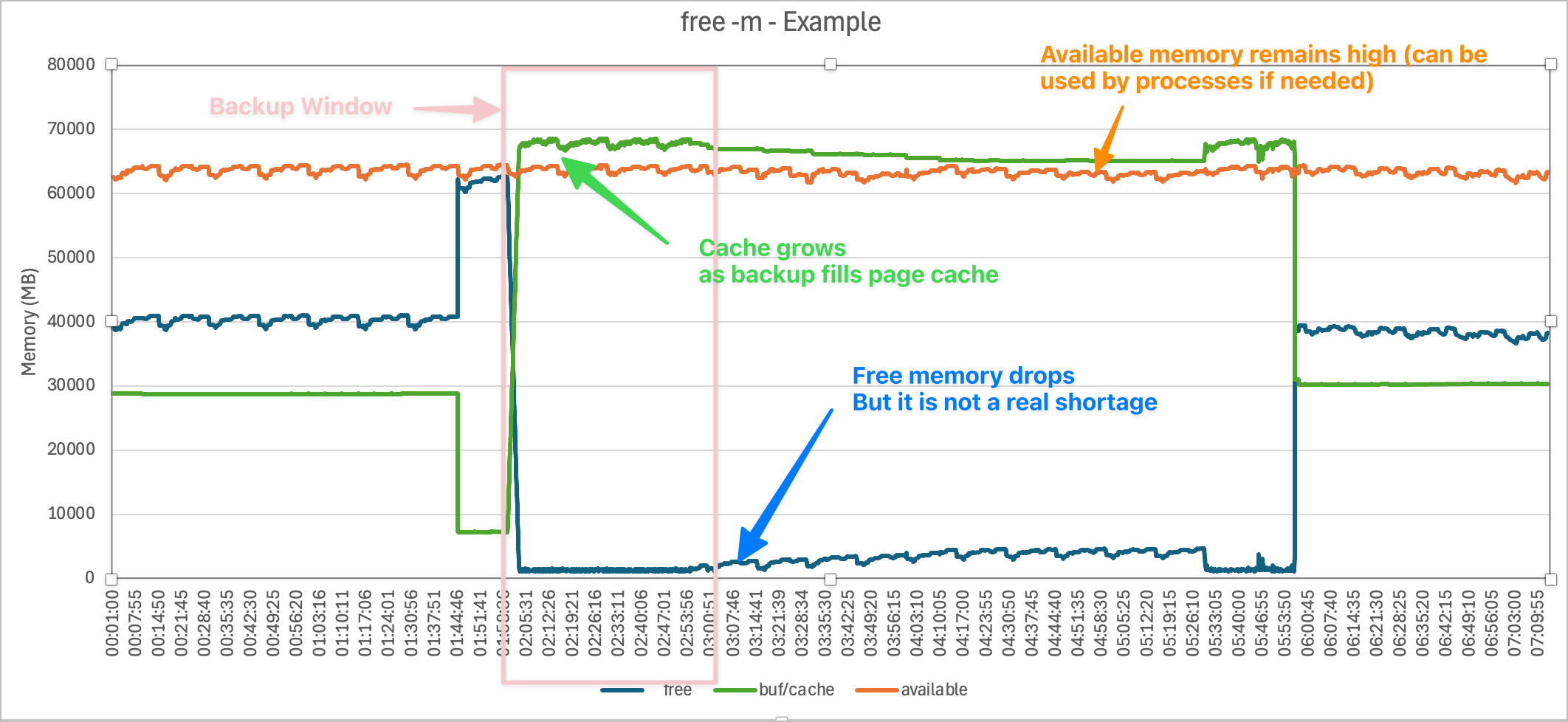
Although free drops near zero during the backup, available remains much higher (tens of GB). That means the system could provide that memory to processes if needed.
By default, free -m does not show huge pages directly. To see them, you need /proc/meminfo entries like HugePages_Total, HugePages_Free, and Hugepagesize.
Because the OS reserves huge pages at startup, they are effectively invisible to
free -m. They are locked away from the general memory pool.
available column, which shows the system still has sufficient headroom.It is common not to use Huge Pages on non-production or systems with limited memory -- performance gains of Huge Pages are usually not significant under 64 GB, although it is still best practice to use Huge Pages to protect IRIS shared memory.
Sidebar. I have seen sites get into trouble by allocating Huge Pages smaller than shared memory, which causes IRIS to try and start with very small global buffers or fail to start if memlock is used (consider memlock=192 for production systems).
Without Huge Pages, IRIS shared memory segments (globals, routines, gmheap, etc.) are allocated from normal OS memory pages. This would show up under “used” memory in free -m. It would also contribute to “available” going lower, because that memory can’t easily be reclaimed.
YES!
For memory protection. IRIS shared memory is protected from:
The command used in ^SystemPerformance for a 24-hour collection (17280 seconds) with 5 second tick is:
free -m -s 5 -c 17280 | awk '{now=strftime(""%m/%d/%y %T""); print now "" "" $0; fflush()}' > ","/filepath/logs/20250315_000100_24hours_5sec_12.log
Hi all,
This is a quick tip about how to use case insensitive URL in REST API.
If you have a class that extends from %CSP.REST and Ens.BusinessService, to create a REST API service, and you have defined your WebApplication in lowercase
XData UrlMap [ XMLNamespace = "http://www.intersystems.com/urlmap" ]
{
<Routes>
    <Route Url="/user" Method="POST" Call="User"/>
    <Route Url="/login" Method="POST" Call="Login"/>
</Routes>
}
Only accepts the url in lowercase, i.e. http://myserver/myproduction/user
If you have any uppercase character, the url doesn't work. http://MyServer/MyProduction/user
.png)
If you are in the business of building a robust High Availability, Disaster Recovery or Stamping multiple environments rapidly and in a consistent manner Karmada may just be the engine powering your Cloning Facility..png)
It's been a while since the new UI for Productions and DTL was published as a preview and I would like to know your opinions about it.
WARNING: This is a personal opinion, totally personal and not related with InterSystems Corporation.
I'm going to start with the Interoperabilty screen:
The style is sober and without frills, following the line of cloud services design, I like it.
But, always a but...or maybe two:
If one of your packages on OEX receives a review, you get notified by OEX only of YOUR own package.
The rating reflects the experience of the reviewer with the status found at the time of review.
It is kind of a snapshot and might have changed meanwhile.
Reviews by other members of the community are marked by * in the last column.
I also placed a bunch of Pull Requests on GitHub when I found a problem I could fix.
Some were accepted and merged, and some were just ignored.
So if you made a major change and expect a changed review, just let me know.
Hi,
I'm trying to run some scripting in Windows. I'm using an instance of the IRISHealth community.
I'm just trying to run a simple sequence of commands so I can run irissession in a non-interactive mode, like:
irissession.exe IRISHEALTH -U "%SYS" < "myprogram.iris"
The contents of my program.iris are, for instance, these ones, to run an online backup:
set$namespace="%SYS"set cbk = "C:\Test1.cbk"set log = "C:\Test1.log"w$$BACKUP^DBACK("","F","MyBackup",cbk,"Y",log,"NOINPUT","Y","Y", 1000, "Test1")
HALT
The execution starts, but then gets completely hung, I see infinitely:
Hello. I need to transform a message
FROM:
MSH|^~\&|
SCH||61490||
PID|1||
RGS|1||1
AIS|1||
AIS|2||
AIS|3||
AIL|1||
AIP|1||
TO:
MSH|^~\&|
SCH||61490||
PID|1||
RGS|1||1
AIS|1||
AIL|1||
AIP|1||
RGS|1||1
AIS|2||
AIL|1||
AIP|1||
RGS|1||1
AIS|3||
AIL|1||
AIP|1||
The RGS, AIS, AIL and AIP are all under the RGS group. The one RGS segment that comes in will be copied across the group. If 3 AIS segments come in then I need 3 RGS groups, if 2 I need 2 RGS groups etc.
The 2025.1.2 and 2024.1.5 maintenance releases of InterSystems IRIS® data platform, InterSystems IRIS® for HealthTM, and HealthShare® Health Connect are now Generally Available (GA). These releases include the fixes for a number of recently issued alerts and advisories, including the following:
Hello community,
I wanted to share my experience about working on Large Data projects. Over the years, I have had the opportunity to handle massive patient data, payor data and transactional logs while working in an hospital industry. I have had the chance to build huge reports which had to be written using advanced logics fetching data across multiple tables whose indexing was not helping me write efficient code.
Here is what I have learned about managing large data efficiently.
Choosing the right data access method.
As we all here in the community are aware of, IRIS provides multiple ways to access data. Choosing the right method, depends on the requirement.
Set ToDate=+HSet FromDate=+$H-1ForSet FromDate=$O(^PatientD("Date",FromDate)) Quit:FromDate>ToDate  Do
. Set PatId=""ForSet PatId=$Order(^PatientD("Date",FromDate,PatID)) Quit:PatId=""Do
. . Write$Get(^PatientD("Date",FromDate,PatID)),!I am looking for a way to capture Data Quality issues with the Source data that is populating HealthShare Provider Directory. 1 way is to use Managed Alerts, but since it could be multiple Providers and different messages it seems silly to alert on every message that has the error. Instead, I was thinking of using the Workflow Engine so it could populate a Worklist for someone to review and work.
Looking over the Demo.Workflow Engine example, I am not comprehending on how to send a task to the Workflow manager to populate the worklist from a DTL.
Hello!!!
Data migration often sounds like a simple "move data from A to B task" until you actually do it. In reality, it is a complex process that blends planning, validation, testing, and technical precision.
Over several projects where I handled data migration into a HIS which runs on IRIS (TrakCare), I realized that success comes from a mix of discipline and automation.
Here are a few points which I want to highlight.
1. Start with a Defined Data Format.
Before you even open your first file, make sure everyone, especially data providers, clearly understands the exact data format you expect. Defining templates early avoids unnecessary bank-and-forth and rework later.
While Excel or CSV formats are common, I personally feel using a tab-delimited text file (.txt) for data upload is best. It's lightweight, consistent, and avoids issues with commas inside text fields.
PatID   DOB Gender  AdmDate
10001   2000-01-02  M   2025-10-01
10002   1998-01-05  F   2025-10-05
10005   1980-08-23  M   2025-10-15
Make sure that the date formats given in the file is correct and constant throughout the file because all these files are usually converted from an Excel file and an Basic excel user might make mistakes while giving you the date formats wrong. Wrong date formats can irritate you while converting into horolog.
Hi all,
Recently we were experimenting with having a variable target on a routing rule and noticed some interesting behaviour, code below.
<rulename="My Rule"disabled="false"><constraintname="docCategory"value="Generic.2.3.1"></constraint><whencondition="((Document.{MSH:MessageType.triggerevent}="A43"))"><sendtransform=""target="To" _(pContext.Document.GetValueAt("MSH:SendingFacility"))_"FromServiceTCPOpr"></send></when></rule>Our application has a ZEN report that accepts a sorting parameter and a fundraiser parameter. Sorting tells us which order the pages are to be in and the fundraiser limits the data shown (e.g. which user has requested the report)
/// the passed in fundraiser parameter
Property fundraiser As %ZEN.Datatype.string(ZENURL = "FID");
Property SortOrder As %ZEN.Datatype.string(ZENURL = "SORTME") [ InitialExpression = "WorkId" ];
.png)
Rancher Government Hauler streamlines deploying and maintaining InterSystems container workloads in air-gapped environments by simplifying how you package and move required assets. It treats container images, Helm charts, and other files as content and collections, letting you fetch, store, and distribute them declaratively or via CLI — without changing your existing workflows. Meaning your charts and what have yous, can have conditionals on your pull locations in Helm values, etc.
If you have been tracking how HealthShare is being deployed via IPM Packages, you can certainly appreciate the adoption of OCI compliance storage for the packages themselves using ORAS... which is core to the Hauler solution.
.png)
Hello InterSystems Community,
I hope you're all doing well. I'm reaching out to ask if there's any way to enable a dark theme or dark mode for the HealthShare Management Portal.
I have a visual impairment (amblyopia/lazy eye) which means I'm nearly blind in one eye. Like many people with visual difficulties, I find that bright white backgrounds and interfaces cause significant eye strain and fatigue. This makes it challenging to work with the Management Portal for extended periods.