#Databases

0 Followers · 366 Posts

InterSystems Caché database is a file where all the data, application scripts, and users, roles and security configurations are stored. Typically the name of the file is cache.dat.

Documentation.

Article Ariel Glikman · Jan 13, 2025 3m read

You may have noticed that to configure a mirror for InterSystems IRIS for Health and HealthShare® Health Connect there is a special requirement. I wanted to go through it step by step in this article.

This assumes you have already configured the second failover member and confirmed a successful failover member status in the mirror monitor:

Step 1:Enable HS_Services user (on backup and primary

Step 2: Switch to Namespace HSSYS and go to Interoperability > Configure > Credentials. Enter the Password for your predefined HS_Services user (on backup and primary)

2
6 380
Article Muhammad Waseem · Feb 28, 2025 7m read

Hi Community, 
In this article, we will explore the concepts of Dynamic SQL and Embedded SQL within the context of InterSystems IRIS, provide practical examples, and examine their differences to help you understand how to leverage them in your applications.

InterSystems SQL provides a full set of standard relational features, including the ability to define table schema, execute queries, and define and execute stored procedures. You can execute InterSystems SQL interactively from the Management Portal or programmatically using a SQL shell interface. Embedded SQL enables you to embed SQL statements in your ObjectScript code, while Dynamic SQL enables you to execute dynamic SQL statements from ObjectScript at runtime. While static SQL queries offer predictable performance, dynamic and embedded SQL offer flexibility and integration, respectively.

8
4 376
Article sween · Nov 4, 2025 11m read

Mirror Your Database Across the Galaxy with Seeding

Hello cpf fans!  This distraction I used the "seed" capability in IRIS to provision an entire IrisCluster mirror, 4 maps wide with compute starting from an IRIS.DAT in a galaxy far far away.  This is pretty powerful if you have had a great deal of success with a solution running on a monolithic implementation and want it to scale to the outer rim with Kubernetes and the InterSystems Kubernetes Operator.  Even though my midichlorian count is admittely low, I have seen some hardcore CACHE hackers shovel around DATS, compact and shrink and update their ZROUTINES, so this same approach could also be helpful shrinking and securing your containerized workload too.  If you squint and feel all living things around you,  you can see a glimpse of in place (logical) mirroring in the future as a function of the operator and a migration path to a fully operational mirrored Death Star as the workload matures.


0
0 31
Article Chi Wan Chan · Oct 30, 2025 2m read

Hi All,

First I want give a Shout Out to @Theo Stolker  and @Rupert.Young. Because they helped me with the solution.

 When you're using the EnsLib.SQL.Snapshot as a Property in the Response Message to return Snapshot data (,e.g.: from Business Operation to Business Process,) the Snapshot data won't be cleaned with the Purge messages task/service.

Class ResponseMessage Extends Ens.Response

{

    Property SnapshotProp As EnsLib.SQL.Snapshot;

}

The data will be stuck in the global: ^Ens.AppData. You can find it with this query in System>Globals:  ^Ens.AppData("EnsLib.SQL.Snapshot",

1
0 49
Question Jerry Wang · Apr 27, 2023

Hi experts

I'm trying to configure an IRIS ODBC connection with "Windows NT authentication using the network login ID". I have created the System DSN as below:

and user (PROD\test) in the SQL Gateway connection 

However, as the error message suggests, IRIS is trying to connect with PROD\svc_mist, rather than PROD\test configured above. 

Is there anyway to configure the ODBC connection with specified account with Windows Auth method? 

3
0 262
Article Yuri Marx · Oct 2, 2024 14m read

In the modern world, the most valuable asset for companies is their data. Everything from business processes and applications to transactions is based on data which defines the success of the organization's operations, analysis, and decisions. In this scenario, the data structures need to be ready for frequent changes, yet in a managed and governed way. Otherwise, we will inevitably lose money, time, and quality of corporate solutions.For a long time, data management and governance were solely based on the data itself, with excellent backup, restoration, ACID (Atomicity, Consistency,

3
1 371
Question Mary George · Oct 8, 2025

Hi Team, 

Can I please check if anyone has built a simple web interface for maintaining custom SQL lookup class.   

We have a simple persistent class in HealthShare which is used for storing Pathology test codes. Test codes in this lookup class is used for message filtering and applying additional logic when processing pathology results/orders. 

We want to make this class available to external users from pathology (not the usual management portal users) to maintain so that they can add/edit/delete test codes as required. 

2
0 74
Article Pietro Di Leo · Oct 6, 2025 5m read

Hi everyone! 👋
I’m excited to share the project I’ve submitted to the current InterSystems .Net, Java, Python, and JavaScript Contest — it’s called IRIStool and Data Manager, and you can find it on the InterSystems Open Exchange and on my GitHub page.

1
2 67
Question Mark Sharman · Sep 30, 2025

At the moment, we have 10 HealthShare instance servers (5 x mirrored pairs), where we implement an External Backup approach, using the freeze/thaw commands against whichever server of the pair is the backup mirror member, to complete a VM level backup. These backups are stored to a disk within our control, to purge as required. This approach allows us to deliver a zero downtime backup approach.

2
0 65
Article Robert Cemper · Sep 22, 2025 2m read

Finishing my previous example for multiple IRIS instances, I tried
to compose a local single instance version.  The step from the external
Python app to a version using embedded Python seemed to be obvious.
This was a wrong assumption, as some Python libraries just refused installation
into my local Windows-based environment.

3
2 68
Question Evan Gabhart · Sep 24, 2025

I am working on a tool that configures an instance to use a common default routine database across all custom Namespaces. For instances that already have distinct default routine databases for their Namespaces, this would involve a step of merging over all code from the current default routine databases to the new "super" routine database. This should be done in such a way that only merges contents in the default routine database (not mapped databases) and is able to detect/exclude contents that already exist in the target database.

11
0 108
Question Rutvik ISM · Aug 19, 2025

I would like to learn about the binary and document reference FHIR Resources. For the PDF data stored in those resources. But I think Binary Resource for the Document PDF stored in FHIR, so this resource is best for it. So sometimes Large PDF 15-page (~35md) data converts into base64 then data length is ~50 lac charecters length of base64binary data. this data store in Binary Resource on data field https://www.hl7.org/fhir/R4/binary.html follow this url this resource used in my case. so it's support the 50 lac charecter of the base64 length? This resource can be Insert into IRIS?

3
0 81
Question Scott Roth · Sep 8, 2025

We currently have Business Operation that we built to use the EnsLib.SQL.OutboundAdapter so we can make Microsoft SQL Server Stored Procedure calls. The BO is attached to a Java Gateway Service.

Some of our MS SQL Databases have moved from being OnPrem to Azure Cloud. We have started seeing where we are receiving errors on the BO saying that we cannot connect to the Azure Database, but we never receive a Disconnect from the Azure Database.

2
0 37
Question Kanishk Mittal · Jul 28, 2025

We’re building out a data lake in IRIS 2025.1 that aggregates data across multiple business systems and departments. I’m trying to establish best practices for schema design and separation.

Right now, I’m thinking of using a separate schema for each distinct system of record feeding into the data lake - for example, one schema per upstream source system, rather than splitting based on function (e.g. staging, raw, curated). The idea is that this would make it easier to manage source ownership, auditing, and pipeline logic, especially when multiple domains are contributing data.

0
0 54
Article Mihoko Iijima · Oct 3, 2024 3m read

InterSystems FAQ rubric

You can check the free disk space at any time using the system utility class: SYS.Database and query: FreeSpace.

Here's how to try it in the IRIS terminal (go to the %SYS namespace and then run it):

zn"%SYS"set stmt=##class(%SQL.Statement).%New()
set st=stmt.%PrepareClassQuery("SYS.Database","FreeSpace")
set rset=stmt.%Execute()
do rset.%Display()

The output result example is as follows:

*In the command execution example, all databases are located on the same disk, so the free disk space (DiskFreeSpace) returns the same value.

1
1 302
Article Myles Collins · Jul 22, 2025 7m read

Are you familiar with SQL databases, but not familiar with IRIS?  Then read on...

About a year ago I joined InterSystems, and that is how IRIS got on my radar.  I've been using databases for over 40 years—much of that time for database vendors—and assumed IRIS would be largely the same as the other databases I knew.  However I was surprised to find that IRIS is in several ways quite unlike other databases, often much better.  With this, my first article in the Dev Community, I'll give a high-level overview of IRIS for people that are already familiar with the other databases such as Oracle, SQL Server, Snowflake, PostgeSQL, etc.   I hope I can make things clearer and simpler for you and save you some time getting started.

1
1 237
Article Henry Pereira · Sep 29, 2024 3m read

sql-embedding cover

InterSystems IRIS 2024 recently introduced the vector types. This addition empowers developers to work with vector search, enabling efficient similarity searches, clustering, and a range of other applications. In this article, we will delve into the intricacies of vector types, explore their applications, and provide practical examples to guide your implementation.

At its essence, a vector type is a structured collection of numerical values arranged in a predefined order. These values serve to represent different attributes, features, or characteristics of an object.

SQL-Embedding: A Versatile Tool

To streamline the creation and utilization of embeddings for vector searches within SQL queries, we introduces SQL-Embedding tool. This feature enables to leverage a diverse range of embedding models directly within their SQL databases, tailored to their specific requirements.

Practical Example: Similarity Search

Let's consider a scenario where we aim to determine the similarity between two texts using the fastembed model and SQL-Embedding. The following SQL query showcases how this can be accomplished:

SELECT
 VECTOR_DOT_PRODUCT(
 embFastEmbedModel1,
 dc.embedding('my text', 'fastembed/BAAI/bge-small-en-v1.5')
 ) AS "Similarity between 'my text' and itself",
 VECTOR_DOT_PRODUCT(
 embFastEmbedModel1,
 dc.embedding('lorem ipsum', 'fastembed/BAAI/bge-small-en-v1.5')
 ) AS "Similarity between 'my text' and 'lorem ipsum'"
FROM testvector;

Caching

One of the significant benefits of using SQL-Embedding in InterSystems IRIS is its ability to cache repeated embedding requests. This caching mechanism significantly improves performance by reducing the computational overhead associated with generating embeddings for identical or similar inputs.

How Caching Works

When you execute a SQL-Embedding query, InterSystems IRIS checks if the embedding for the given input has already been cached. If it exists, the cached embedding is retrieved and used directly, eliminating the need to regenerate it. This is particularly advantageous in scenarios where the same embeddings are frequently requested, such as in recommendation systems or search applications.

Caching Benefits

  • Reduced Latency: By avoiding redundant embedding calculations, caching can significantly reduce query response times.
  • Improved Scalability: Caching can handle increased workloads more efficiently, as it reduces the strain on the underlying embedding models.
  • Optimized Resource Utilization: Caching helps conserve computational resources by avoiding unnecessary calculations.

In conclusion, the introduction of vector types in InterSystems IRIS presents a robust tool for working with numerical object representations. By harnessing similarity searches, SQL-Embedding, and various applications, developers can unlock new possibilities and enhance their data-driven solutions.

If you found our app interesting and contributed some insight, please vote for sql-embeddings and help us on this journey!

2
2 279
Question steven Henry · Jul 10, 2025

Hello my friends,

I have a problem with logi report, 

in my store procedure,  I create code like this?

$ListToString(%DLIST(DISTINCT (ARCIM_Desc)),'<br/>') as "ARCIM_Desc", -> this is the problem

$ListToString(%DLIST(DISTINCT (MRDIA_ICDCode_DR)),'<br/>') as "MRDIA_ICDCode_DR", -> it's works fine

as you see there's a <br/> in the display of the report

I have no idea about this, maybe someone can help me fix this problem ?

Thank You

Best Regards,

Steven Henry

4
0 95
Question steven Henry · Jul 10, 2025

Hello my friends,

I have a problem with Objectscript, why the value of address become like this ?

everything works fine except the Address,

this is my code, do I need something to make this into real address ? should I put something in my code ? 

 set paper=obj.PAADMPAPMIDR.PAPMIPAPERDR

            if '$isobject(paper) continue

            set Address=paper.PAPERStName

thank you for your help

Best Regards,

Steven Henry

3
0 70
Question Norman W. Freeman · Jun 27, 2025

I have notified that on several servers the IRISTEMP database is reported as only a few GB in size while on the disk where it's located, the IRIS.DAT file is much bigger (eg: 3GB reported in Portal (including free space) while file on the disk file is 121GB). The last modification date of IRIS.DAT is recent so I'm not looking into a location no more in use.

Is there an explanation for that difference in size ? 

I know temporary databases are special in a way they are not always stored on the disk, here is what InterSystems says about it :

4
0 91
Article Harry Tong · Jun 6, 2025 2m read

If you're migrating from Oracle to InterSystems IRIS—like many of my customers—you may run into Oracle-specific SQL patterns that need translation.

Take this example:

SELECT (TO_DATE('2023-05-12','YYYY-MM-DD') - LEVEL + 1) AS gap_date
FROM dual
CONNECT BY LEVEL <= (TO_DATE('2023-05-12','YYYY-MM-DD') - TO_DATE('2023-05-02','YYYY-MM-DD') + 1);

In Oracle:

1
0 99
InterSystems Official Daniel Palevski · Jun 9, 2025

InterSystems has released new point updates to resolve a defect affecting the most recent prior versions of 2025.1.0, 2024.1.4, 2023.1.6, and 2022.1.7, for the following supported product lines:

  • InterSystems IRIS
  • InterSystems IRIS for Health
  • HealthShare Health Connect

This issue could result in unexpected <PROTECT> errors or access anomalies when using features such as:

  • Implied namespaces
  • Mixed read-only/read-write access to databases
  • Management Portal pages for listing routines and globals

Symptoms Included:

1
0 129
Question Norman W. Freeman · May 20, 2025

Hello,
I have created this script that does lot of writes to a single global. DB write performance is much slower than expected (compared to another similar systems).

set rec = "..."//fill it with somethingset time = $piece($horolog,",",2)
while(($piece($horolog,",",2)-time) < 30) //30 secondsset^A($System.Util.CreateGUID()) = rec
}

I have notified the following : 

9
1 186
Article Guillaume Rongier · Apr 9, 2019 3m read

IRIS and Ensemble are designed to act as an ESB/EAI. This mean they are build to process lots of small messages.

But some times, in real life we have to use them as ETL. The down side is not that they can't do so, but it can take a long time to process millions of row at once.

To improve performance, I have created a new SQLOutboundAdaptor who only works with JDBC.

BatchSqlOutboundAdapter

Extend EnsLib.SQL.OutboundAdapter to add batch batch and fetch support on JDBC connection.

Benchmark

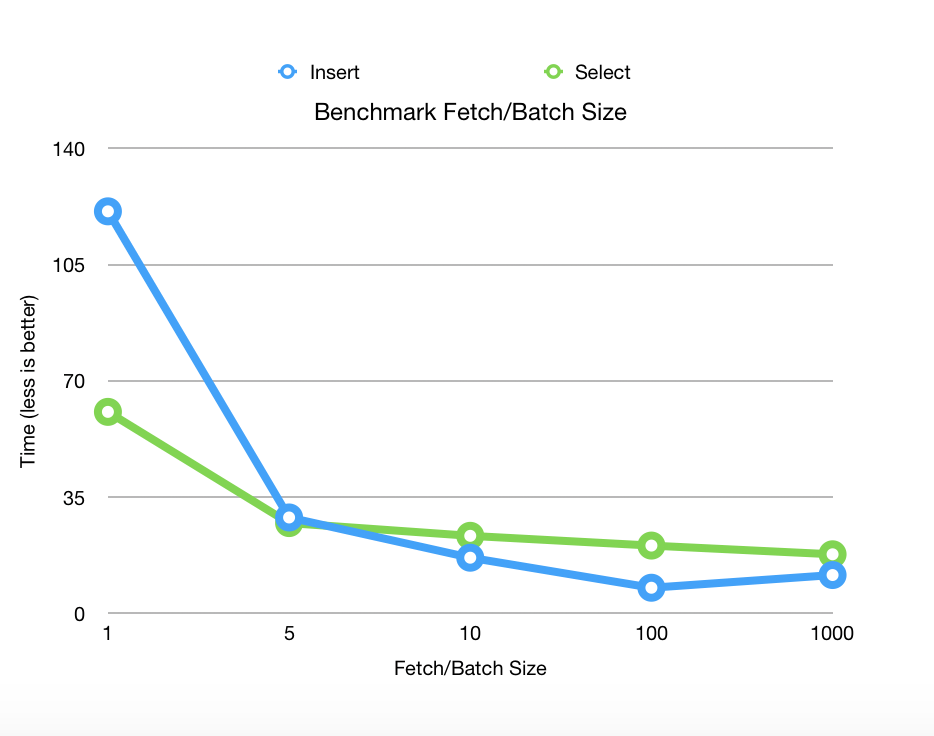
Benchmarks released on Postgres 11.2 with 1 000 000 rows fetched and 100 000 rows inserted on 2 columns.

alt text

Prerequisites

Can be used on IRIS or Ensemble 2017.2+.

Installing

Clone this repository

git clone https://github.com/grongierisc/BatchSqlOutboundAdapter.git

Use Grongier.SQL.SqlOutboundAdapter adaptor.

New methods from the adaptor

  • Method ExecuteQueryBatchParmArray(ByRef pRS As Grongier.SQL.GatewayResultSet, pQueryStatement As %String, pBatchSize As %Integer, ByRef pParms) As %Status
    • pRS is the ResultSet can be use as any EnsLib.SQL.GatewayResultSet
    • pQueryStatement is the SQL query you like to execute
    • pBatchSize is the fetch size JDBC parameter
  • Method ExecuteUpdateBatchParamArray(Output pNumRowsAffected As %Integer, pUpdateStatement As %String, pParms...) As %Status
    • pNumRowsAffected is the number of row inserted
    • pUpdateStatement is teh update/insert SQL statement
    • pParms is Caché Multidimensional Array
      • pParms indicate the number of row in batch
      • pParms(integer) indicate the number of parameters in the row
      • pParms(integer,integerParam) indicate the value of the parameter whose position is integerParam.
      • pParms(integer,integerParam,"SqlType") indicate the SqlType of the parameter whose position is integerParam, by default it will be $$$SqlVarchar

Example

  • Grongier.Example.SqlSelectOperation show an example of ExecuteQueryBatchParmArray
  • Grongier.Example.SqlSelectOperation show an example of ExecuteUpdateBatchParamArray

Content of this project

This adaptor include :

  • Grongier.SQL.Common
    • No modification, simple extend of EnsLib.SQL.Common
  • Grongier.SQL.CommonJ
    • No modification, simple extend of EnsLib.SQL.CommonJ
  • Grongier.SQL.GatewayResultSet
    • Extension of EnsLib.SQL.GatewayResultSet to gain the ablility to use fetch size.
  • Grongier.SQL.JDBCGateway
    • Use to allow compilation and support on Ensemble 2017.1 and lower
  • Grongier.SQL.OutboundAdapter
    • The new adaptor with :
      • ExecuteQueryBatchParmArray allow SQL query a distant database and specify the JDBC fetchSize
      • ExecuteUpdateBatchParamArray allow insertion in a distant database with JDBC addBatch and executeBatch
  • Grongier.SQL.Snapshot
    • Extend of EnsLib.SQL.Snapshot to handle Grongier.SQL.GatewayResultSet and the fetch size property
10
3 1851