Hi Mike,
Might be worthwhile to add a tag for "Newbie's Corner" to make these easier to find. Search does a reasonable job, but brings up more than just these articles.
- Log in to post comments
Hi Mike,
Might be worthwhile to add a tag for "Newbie's Corner" to make these easier to find. Search does a reasonable job, but brings up more than just these articles.
I'm attempting to use Squirrel on a Windows system with a locally-installed version of Caché/Ensemble 2014.1. Unfortunately, the version of the JRE on that system is 1.6, with which Squirrel is incompatible. Updating the JRE to 1.8 allows Squirrel to work, but breaks the JDBC gateway and client functionality in Caché. Both applications check the JRE version in the Windows registry on initialization, so messing around with PATH and CLASSPATH don't solve the problem.
Any thoughts?
PS. Upgrading to a more current version of Caché is not currently an option; this is a customer system.
According to the Caché log file, it's looking at the registry to get the version as well.
I've "hacked" around the issue by creating two registry import files, one that sets the version of the JRE to 1.8 and the other to 1.6. I import the 1.8 version (regedit /s jre18.reg) in Squirrel's startup batch file just before Squirrel is launched, and the 1.6 version after (regedit /s jre16.reg). It all happens fairly seamlessly, although I did have to insert a short delay in the batch file before the return to version 1.6 using the Win 7 'timeout' (timeout /t 1) command.
InterSystems Corp
Mashes Objects onto Mumps
Can you handle it?
;)
While I'm not the original poster, Dmitry, I find your answer to be useful. I've had occasions where the output from zw would have been useful in Ensemble traces. Thanks!
Brendan,
Are you fixing the documentation to remove the reference to scp, or fixing %Net.SSH.Session to support it? From the way your answer is worded, I'm suspecting the former ...
sftp and scp are individually configurable services in ssh, and in my experience you can't be guaranteed that one or the other is available at a given customer site. If scp currently isn't supported, it would be useful to have. Getting sysadmins to turn on services that are purposely disabled can be ... challenging :)
Steve, when I worked with the WRC to configure this (back in 2015), I got significant pushback on attempting to use the "private" server. I'm not sure what will happen with an in-place upgrade, either.
That may have changed since then. Regardless, installing the CSP gateway on an external, standalone web server is a solution supported by ISC, so please take that into consideration as you plan your implementation of SSL.
I had only one entry in CSP.ini, for LOCAL. The server name was configured appropriately, and the '/' app path was routed to it. I don't have an explicit path to '/api' but there wasn't one in the "private" web server's CSP.ini either and that works fine for Atelier.
I've removed the CSPFileType directive and am getting the same result ... "Not Found."
EDIT: And, of course, restarted Apache :)
I've backed out all of the changes that I would have suspected might have an impact, and it's still working (and yes, I've restarted both Apache and Caché). The only thing I haven't yet backed out was the creation of a non-SSL site on port 8881, but that's something I did early on and am fairly certain I tried an Atelier connection after. But I may be misremembering ...
So there's a 1.1 beta channel for Atelier listed here: https://download.intersystems.com/download/atelier.csp#auto-update
Is there a changelog somewhere for that? I'm just wondering what features from the current roadmap are available for testing.
Thank you, Joyce. Looking forward to seeing what's working!
FYI, updating to Oxygen seems to have fixed one issue I had intended to report (the debugger would drive my standalone Apache server's memory and CPU utilization through the roof).
I would love to, but as it's been deleted I'm not sure exactly how I would do that 
The closest I can come is this: https://community.intersystems.com/post/overwrite-file#node-433196, which is the URL provided by the "Answer:" link circled in the attached.

Yes, that's the link I posted in response to Evgeny's request. Looks like we just missed each other
Stuart, have you verified that the merge message parses correctly? Check the contents of the message in the message viewer and verify that the MRG segment isn't displayed in black text. If the segment doesn't parse against the schema and doctype specified in the inbound service, the HL7.{} field selectors referencing it won't work.
Hmm. Interesting. I created the exact same rule as your original in my local testing environment and it worked as expected. I was not using the testing service, however. I'm running HS 2017.1 if it matters.
What's at line 12, offset 40 in the Import file?
I'd like to join as well, Evgeny. Thank you.
Re-reading the question, this probably makes more sense than my answer 
It appears as though an expression won't work in the target field. Interestingly, though, this actually compiles for me on 2017.1:

It errors when the rule executes:

I've done dynamic routing in a BPL code bock using ObjectScript, though, and you could certainly write your own BP in Studio for it ... see the methods SendRequestSync()/SendRequestAsync() in Ens.Host, of which Ens.BusinessService/BusinessOperation/BusinessProcess are subclasses.
Really should have been an answer ... moved
If you're working with messages coming in from an HL7 service, the doctype will likely already be set. I only set it in my example because I used the ImportFromFile() method, which does not automatically select a schema and DocType category.
The DocType essentially defines the message object's rules use for parsing the message, so without one, you won't really be able to do much with them.
You could do some basic parsing/counting with $PIECE and some loop constructs against the raw message, but that doesn't sound like a lot of fun ...
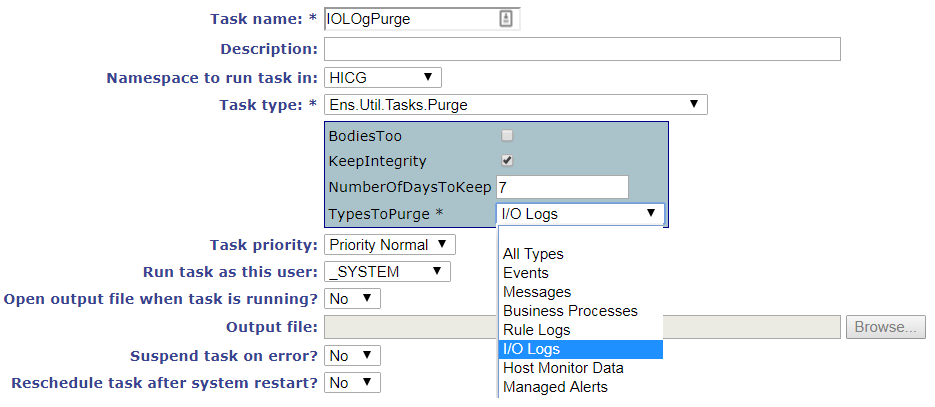
Are you sure you're looking at the right task? I/O logs would normally be purged using Ens.Util.Tasks.Purge, which is also used to purge messages, alerts, and other production logging. Here's a task I created specifically for demonstration purposes. You won't find this in your scheduled task list by default. You may have another, similar task that someone may have set up in your environment, though:
It's not a character set problem, it's a malformed HL7 problem. If the vendor sending the message needs to include a carriage return character in the middle of a segment, they should be escaping it.
If the vendor won't fix it, you're probably looking at overriding the inbound service's OnProcessInput() method to strip out \0x0D\0x0A sequences and replace them with something else. If they're in there for textual formatting purposes, you'll need to know what the target system expects for a line-break character sequence.
There aren't any "userland" settings in the HL7 service configuration that will allow a carriage return to be treated as both a segment delimiter and, well, not a segment delimiter. They're mutually exclusive.
This situation is one of the reasons why InterSystems supports custom services ...
Evgeny, I received a registration confirmation on Wednesday; do I need to re-register?
@Eduard, where is the macro $$$comClassDefined defined?
Hi Eduard,
(well, nevermind, then ... still a useful exercise for me )
Ugh, and this is why I should do a page refresh before posting a comment/answer ...
I was pretty sure it was an issue with the web application definition, but didn't think to remove the dispatch class when I tested ...
Hi Scott,
What metadata are you referring to? Document properties such as Title, Author, Subject, Keywords, etc. or are you looking to actually extract patient data from formatted page elements?
It doesn't look like HealthShare has any built-in PDF parsing features, but there may be something developed by the community (if there is, I'm not aware of it, though). If it's the properties I mentioned above, though, they're normally stored near the end of the file and it's conceivable that you could scrape them out with COS. To do it right, though, I think you'd want to call an external utility to fetch it. The pdfinfo utility in xpdf does that pretty efficiently:
jdrumm@oobuntoo:/mnt/hgfs/DDownloads/Intersystems$ pdfinfo Sample.pdf
Title:          Sample
Subject:        Just another pdf
Keywords:       test metadata cache fetching
Author:         Jeff Drumm
Creator:        PDFCreator Version 1.7.3
Producer:       GPL Ghostscript 9.10
CreationDate:   Wed Aug  2 07:32:38 2017
If you're looking to get data stored as formatted page elements, though, that's an entirely different challenge.